I started my trip on April Fools Day. It was one of those days where something seemed to go wrong at every turn. Thankfully I survived, as did (almost) all of my gear, and I can say that the day left me “tougher”, not “tireder”.
In keeping with my theme of low-carbon kayaking, I took myself and all my stuff on the Canada Line Skytrain line south from downtown Vancouver to Richmond, BC, near the international airport. This is right on the floodplain of the Fraser River, the largest river in BC, and the most southerly of the 10 BC rivers that flow through the Coast Mountains. It is in this exact spot that I plan to finish my trip next year when I complete the circle around the Coast Mountains.

Low carbon kayaking
I had looked on Google Earth and saw that there was an easy 1 km walk between the skytrain station and an access point to the river. Unfortunately, I took the wrong turn while walking and ended up having to walk 3 km the other way down the river, only a short distance away from it but unable to reach it because of a trench and fence (and an important wildlife area, so I can’t be too ticked off).
When I finally reached the river at MacDonald Park, I noticed that I had left my video camera running for the whole walk and had almost run the battery dry with a half hour of footage of the roadside. It’s gonna be one of those days … the more frustrated you get, the less attention you pay to what’s happening and then even more things go wrong. Luckily, I had brought another battery with me, and I also had another video camera safely inside its underwater housing.

At the Fraser River ... finally
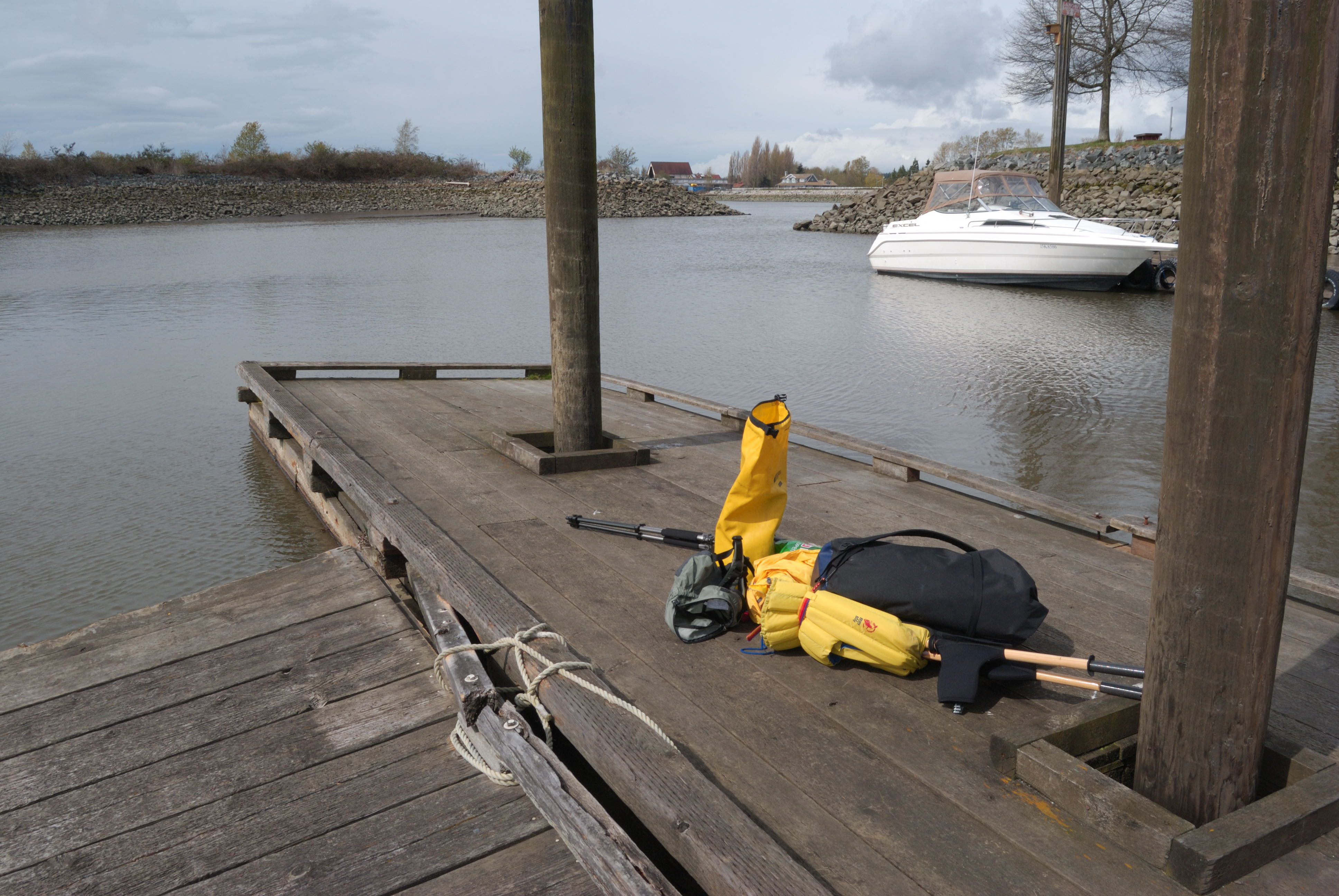
At the dock, since the bench above was not near an easy entry point to the river
I walked down the dock ramp and organized myself in some nice semi-sunshine. It was starting to come together. I finally entered the mighty Fraser and was immediately swept downstream in a swift current on a low tide. The river really flows here. You don’t really realize it while looking at it from the road. Luckily I wasn’t fighting a rising tide, which would counteract the river flow. For a few kilometers I leisurely paddled downstream, going many times faster than my effort would suggest. I like this sluggish river kayaking.

A happy couple
I was trying to get video footage of myself paddling and speaking at the same time. It all works well in the controlled setting of a house, but it will take some time to get it all sorted out in the kayak. I have so many little things to keep track of, and there’s water flying everywhere from the paddle. What I need is to have each of my several cameras in its own waterproof bag with a little towel in each, so that when I take it out my hands are dry and there is nothing else in the bag that gets in the way. Just more waterproof bags to buy…..

Chip barge and processing conveyors
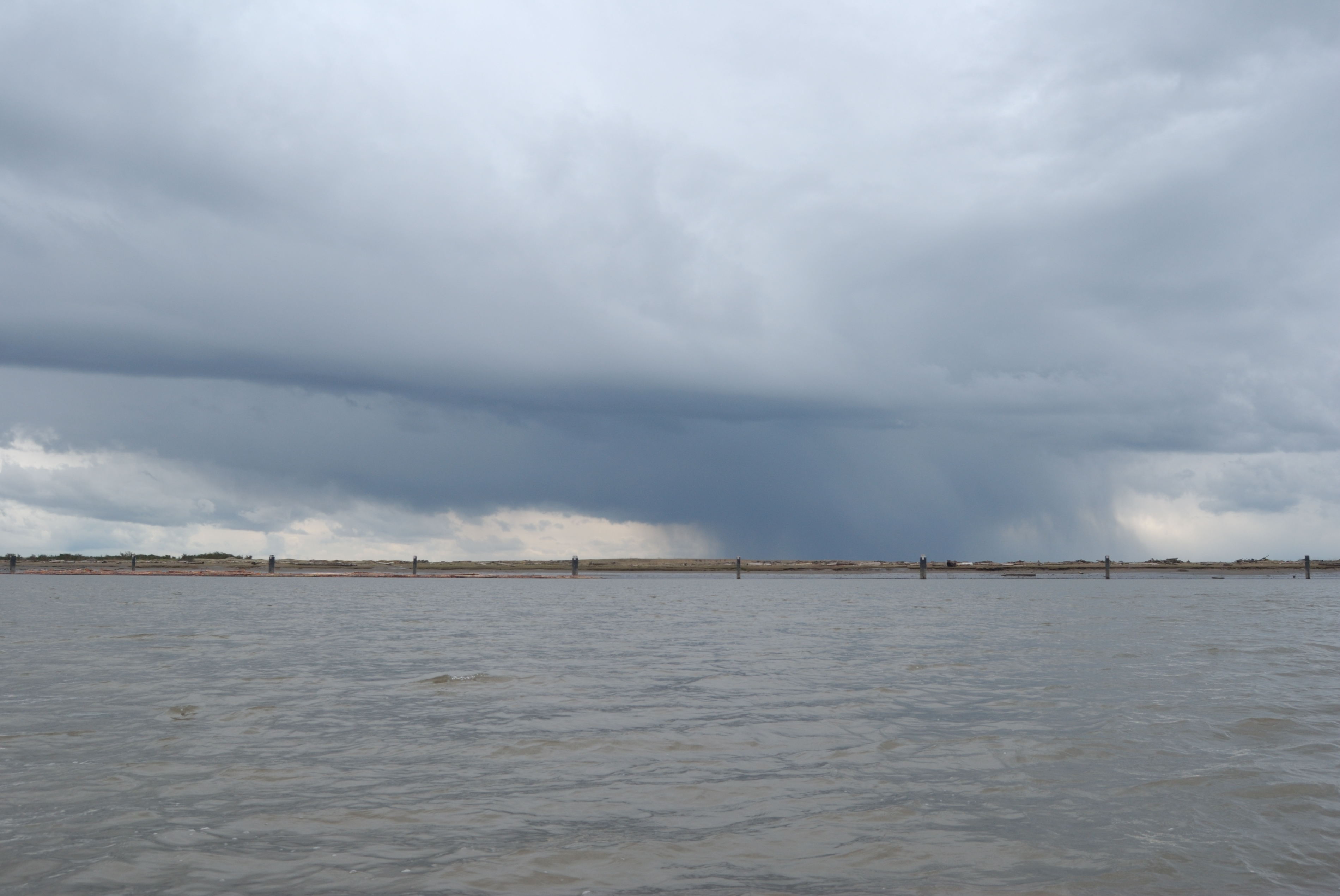
Developing squall over Richmond to the south
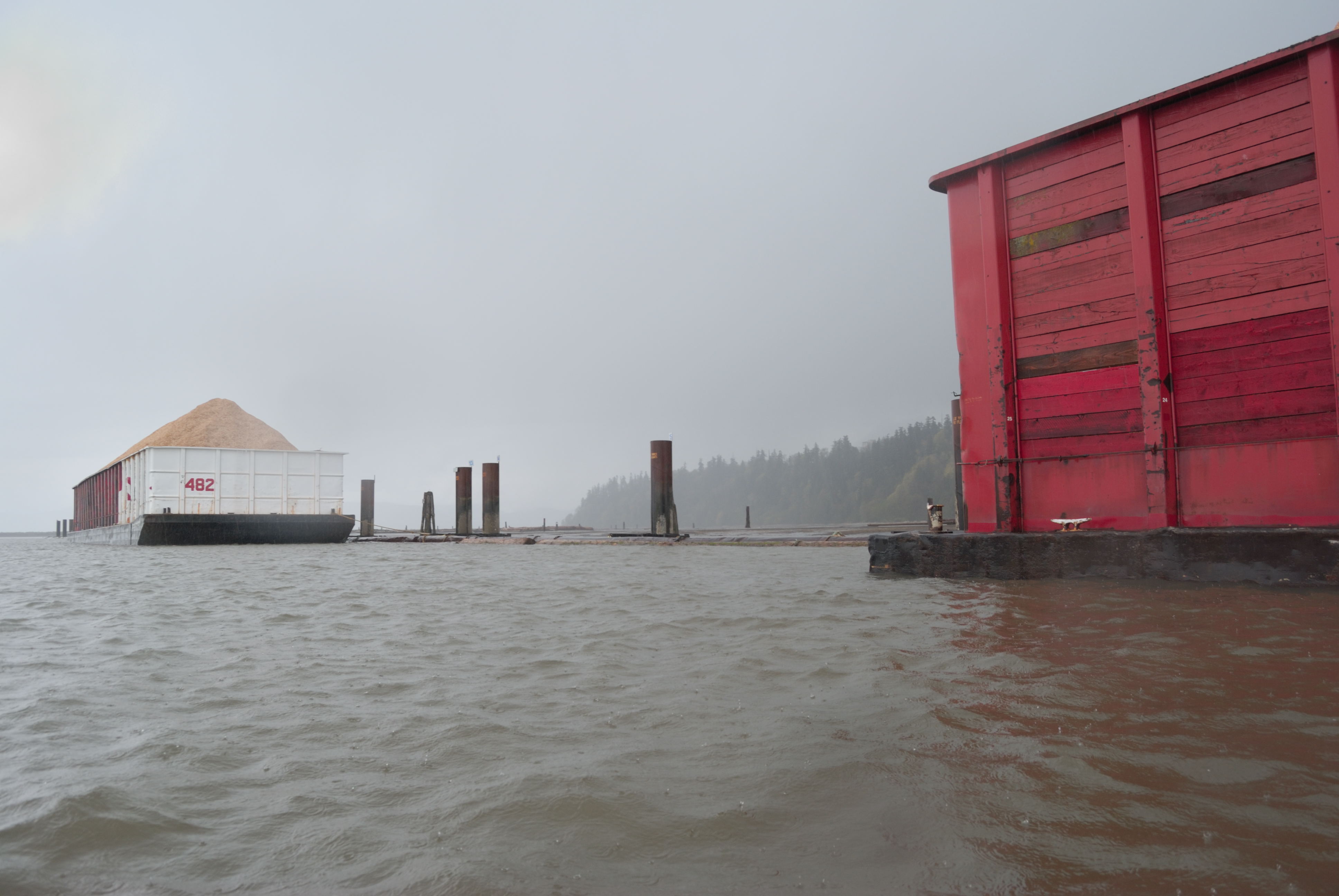
Right after the squall

Taking refuge against the log boom
The speed of the river slowed as I approached the ocean. Along each side were log booms and mud banks, and the odd barge of wood chips. Cottonwoods dotted the riverside forest, one patch full of noisy starlings. All along I could hear the call of the redwing blackbird, a nice sign of spring. Lots of mergansers and coots too, along with the usual west coast familiarities of the great blue heron and bald eagle.
I noticed a squall to the south, and based on the wind direction, prepared to get hit with it. It didn’t take long, and it came like a wall. I took refuge against a log boom and put on my raincoat, and everything was fine! That’s what rain gear is for, I guess. After 10 minutes it eased up.
I continued on past the last marker denoting the beginnings of Wreck Beach beside the University of BC. It was interesting to be seeing UBC from the reverse direction, after so long behind a desk there looking out. As I rounded Point Grey I got hit with a headwind. It didn’t abate and my wrists were getting a bit sore – I am trying to keep some tendonitis from flaring up. I decided to get out at Alma Street. As I passed Jericho Beach I ended up on the expansive sand flats in about a foot of water. These extend a long way out from shore. Luckily, a foot of water is six inches more than I need, so I kept on. Years before I had come here to dig up mud shrimp for the aquarium. I wasn’t in the mood to go searching thus time, so maybe another day. These are interesting guys that live in little tunnels and move sand around like earthmovers.

Vancouver's North Shore viewed from Point Grey
On the wind coming from the east from downtown Vancouver I could smell the cottonwoods leafing out, probably from Kits Beach. While I was contemplating the nice aromas on the breeze, I also noticed dark clouds forming to the south over Vancouver near UBC, and the increasing wind speed. I was aiming to get to the Vancouver Sailing Club’s beach, since this would be my take-out point. About a kilometer from the destination, I got hit with another squall, but this one was major. Apparently it gusted to 40 knots and turned over some small sailboats at the dock. The rain was coming down in horizontal sheets and I was getting hammered from the side by strong wind. Luckily, with this direction of wind, the short distance from shore prevented any really large waves from forming.
I am happy to say that my kayak handles rough seas very well. It is very difficult, if near impossible, to capsize when fully loaded, except maybe in crashing surf. That is the advantage of an inflatable with pontoons on either side! The drawback, of course, becomes clear if it springs a leak. So I will have to take extra caution to avoid that….. I will also bring plenty of repair equipment. The dangers for getting a leak are the razor sharp barnacles and mussels on the shore. I will also try to avoid bothering sea lions, since I would not want one testing out my boat. I plan to rarely be far from shore, and when I am forced to cross open water I have a drysuit and VHF radio in case of an emergency.
The advantage of this kayak is that it packs up into a 30 pound backpack, with which you can hike through the bush. This opens up many opportunities for me to explore some unique places along my trip up the Coast (in other words, LAKES and RIVERS!), which I would otherwise be unable to do, being restricted to the ocean. My kayak isn’t quite as fast as a regular sea kayak, but it’s no slouch. It’s all about compromises, and this trip isn’t about speed.
I landed on shore and began breaking up the boat, walking around in bare feet on the sandy beach in a 7 degree C squall. Yes, I was a little cold. Fortunately, when you are doing something strenuous you also make heat so you stay warm. The problem is when you stop doing what you are doing — then you get cold. It was an interesting sensation to put my feet in the ocean on April 1, and the water felt warm.
I managed to walk up to Broadway with my stuff and catch the 99 B line bus back to the skytrain, along with the other UBC students heading home after a day in class. Day’s numbers: 5 km of walking, 17 km of paddling, many km of public transit. Luckily my tendonitis didn’t act up. This was a difficult day, and my performance is promising.
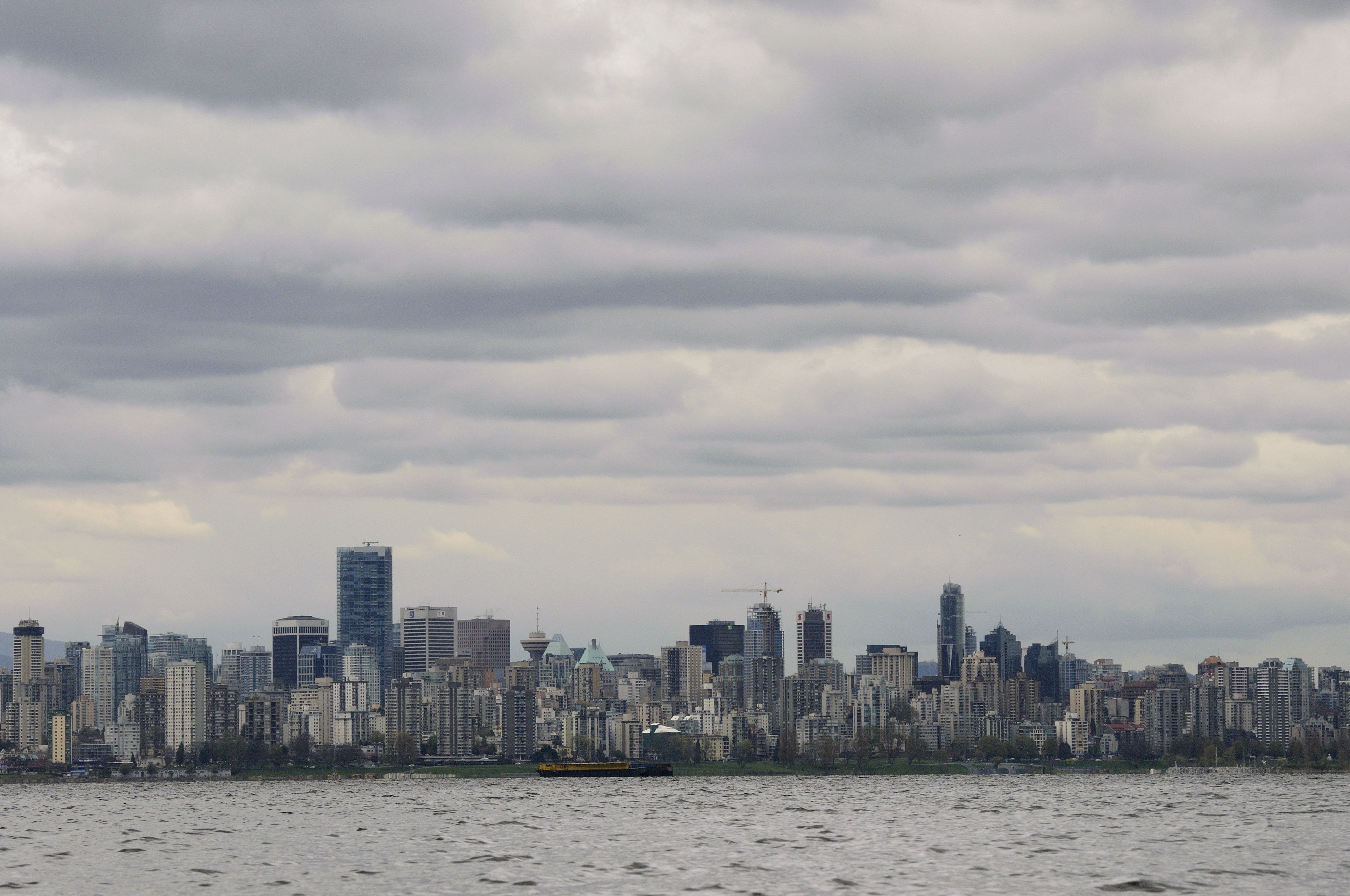
Downtown under the bad weather
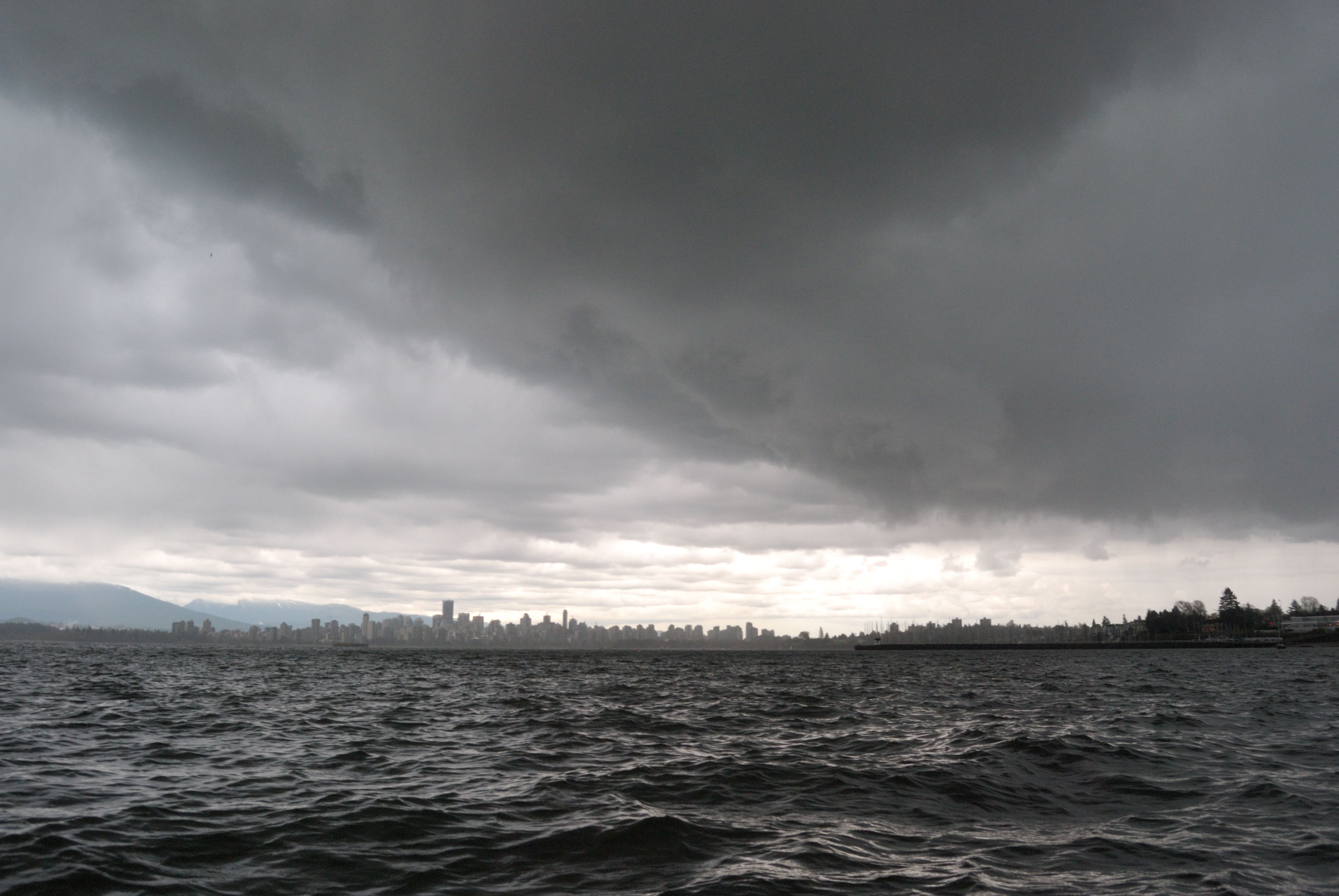
Yikes

The Lions Gate Bridge getting hammered

A small portion of the pod of seals who were wondering what I was all about

"What are you doing?"
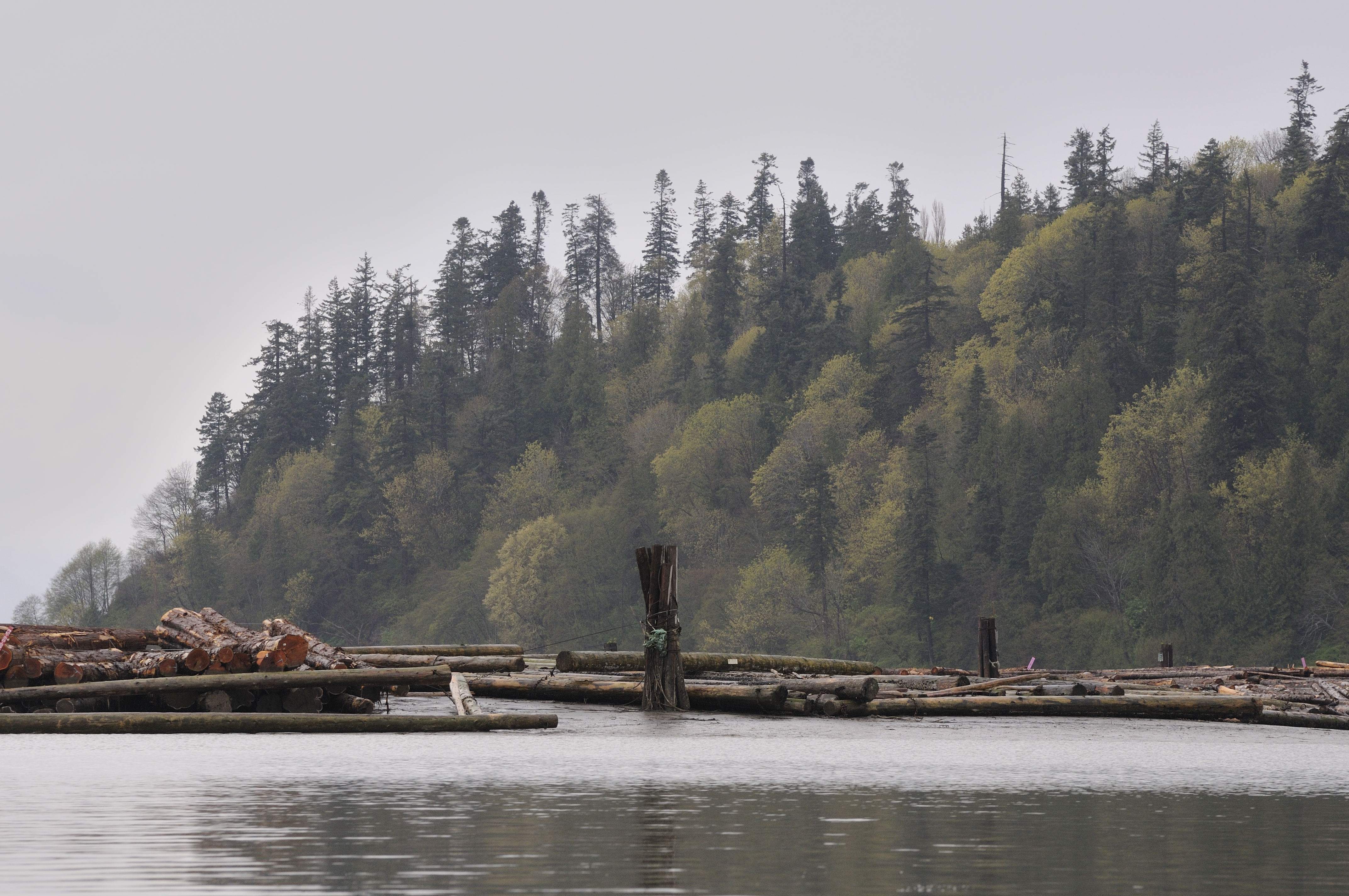
UBC and Wreck Beach behind the last of the log booms

A tug boat doing its work on the river, against a backdrop of spring storms
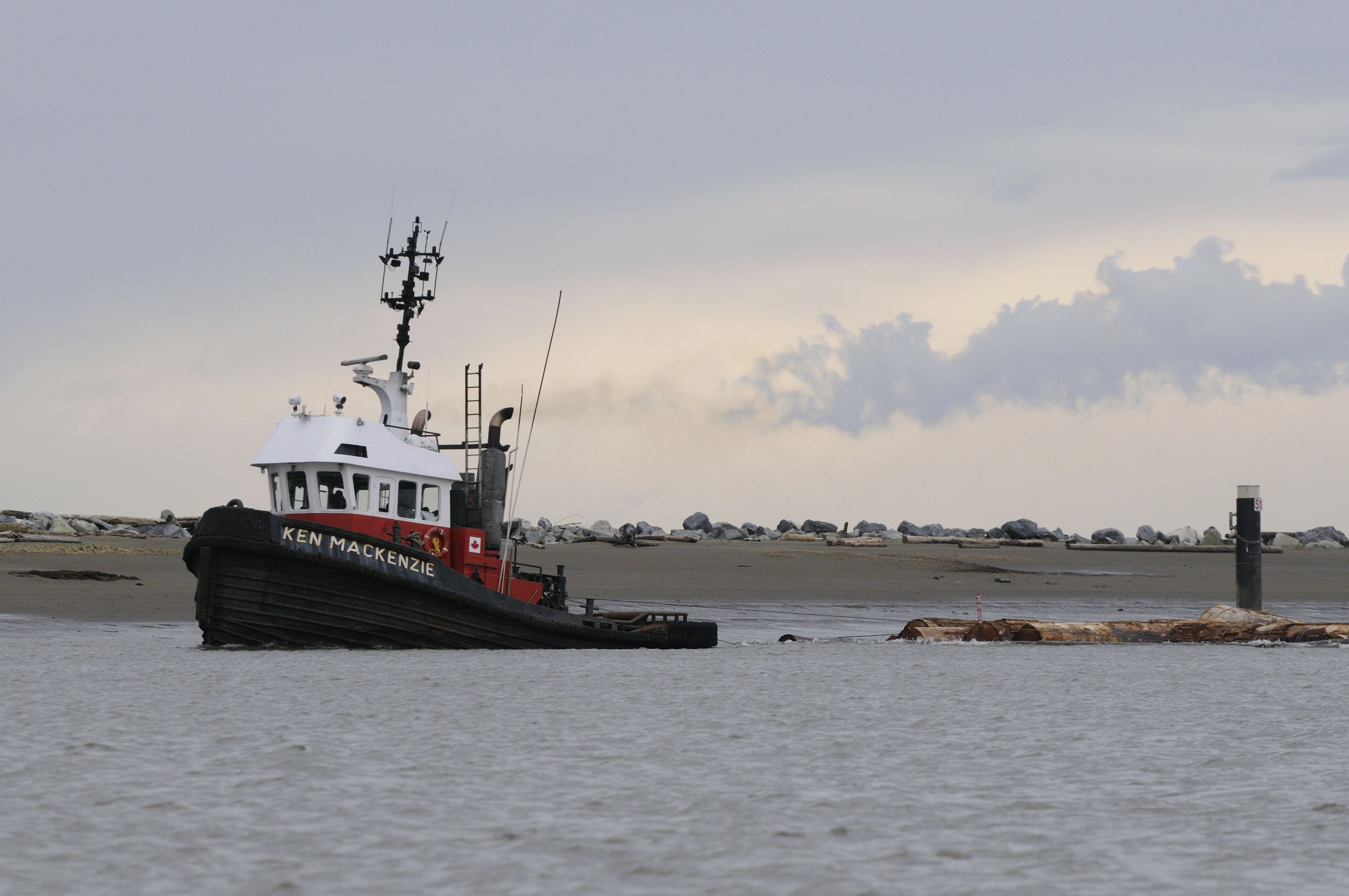
Fortunately, I was going downstream, not up. The tugs have the power to pull logs either way.

A bald eagle taking a break on the mud flat. I think I'll see a few more of these guys...
 Around the Coast Mountains