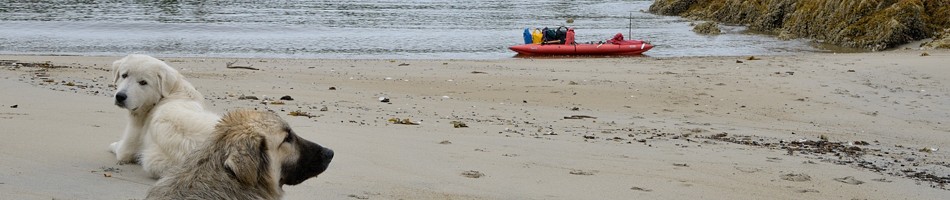
By the next morning there was still no sign of Eva and the sailboat out in the bay, a group of young teenagers from Tacoma on a Search and Rescue course along the coast, helped out. Well they were getting their field training! They broke into two groups and set out along each shore of the lake. The leader had decided to call Search and Rescue and the helicopters flew overhead. But then a Coast Guard zodiac came around the corner with Eva and the dog Coco in it. She had somehow made it over the mountain and had started making her way back to camp along the shoreline, and was only just past the closest point. The zodiac saw her and picked her up. The shoreline was steep so it would have taken here a long time to get over. Anyways, she was back unharmed. It just goes to show how easy it is to get lost if you get overconfident and caught unprepared. She had never been lost before!
I went out and got underwater videos of the moon jelly school in the bay. This turned out well and I was happy about that, since I had missed the opportunity the day before out in the crossing.
I carried my boat up to the lake since I was looking forward to paddling in some fresh water. It had been a nice evening on the lake yesterday and I hoped to get out on it today. However, today was windy, really windy. But I wanted to paddle in fresh water so I went out anyways.

Setting off into the wind on Unwin Lake

There was interesting lakeshore life with boggy type vegetation growing on the floating logs. Among these plants is sundew, which is adapted to environments with low nutrient availability and instead gets nutrition by trapping insects in sticky hairs on its leaves, and then it digests them.

Relic of an old burn here in the dry forests of Desolation Sound
I passed by the knoll which we had hiked to the previous night. It only took a few minutes by boat, but over half an hour to walk there. It is good that we turned around where we did last night as we would not have gotten aywhere. The headwinds were very strong but I continued on to the second lake.
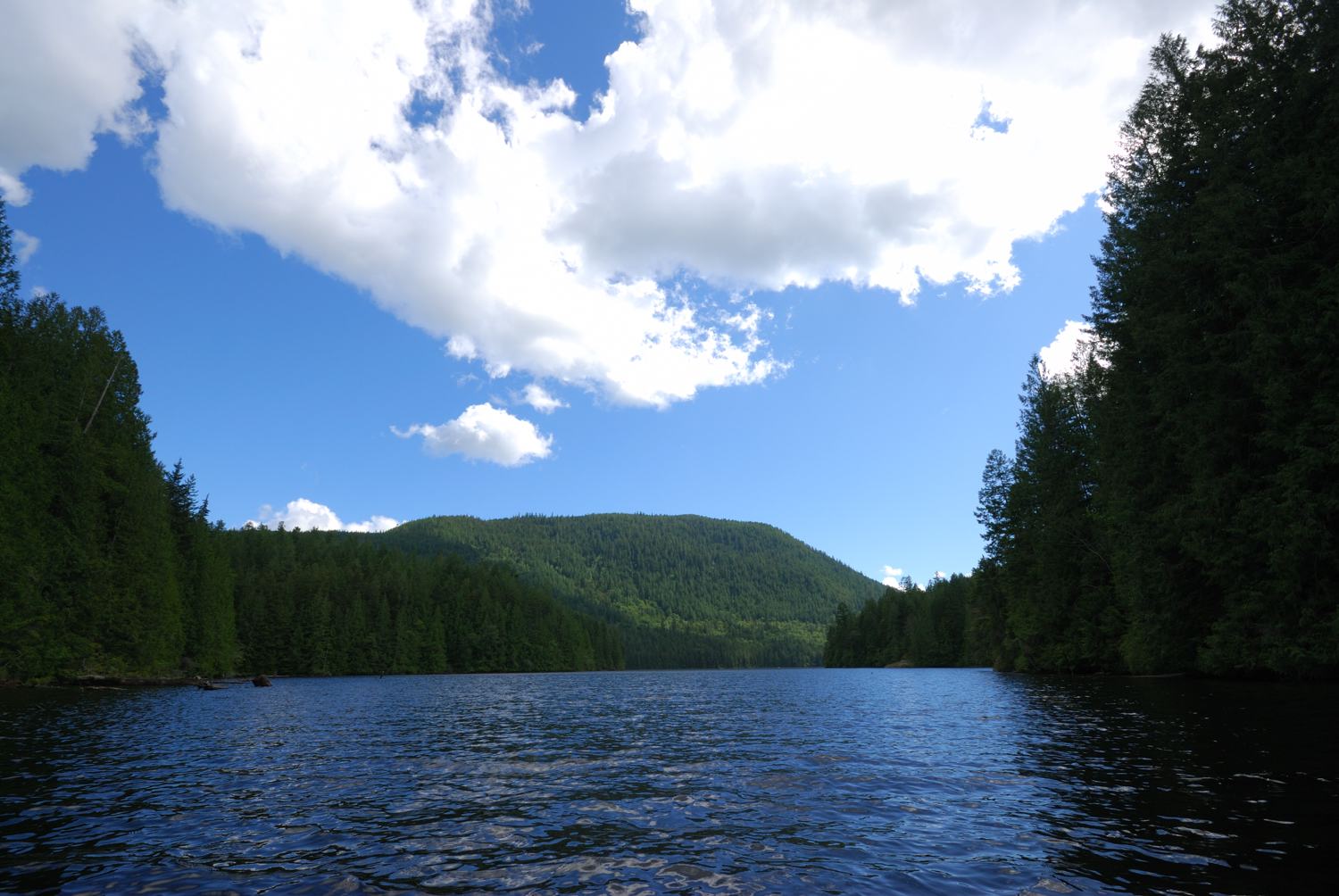
Going through the narrows between the two lakes

Freshwater mussels
I paddled past some rocky bluffs that went down to the lake that had interesting mossy dry vegetation.

oregon stonecrop


Lily pads the southern end of South Unwin Lake. The wind had pushed me here and I was hoping I’d be able to get back!
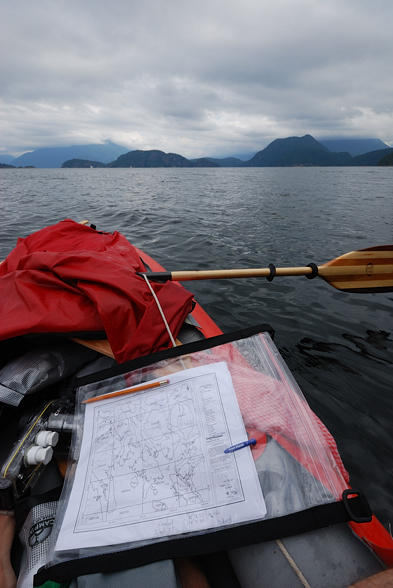
After reaching the end of the lakes I now had to paddle back against the wind. It was a hard paddle as I crept up the east shoreline, aiming for the northern shore which looked to be in a sheltered lee.

The northern shoreline where I could get out of the wind

Douglas-fir bark beetles are usually found in the Interior but they have been moving out to the Coast. These are related to the pine beetle, which has laid waste to massive swaths of pine forests in the Interior. Much of my return trip later on through the Interior will be through the remnants of these forests.
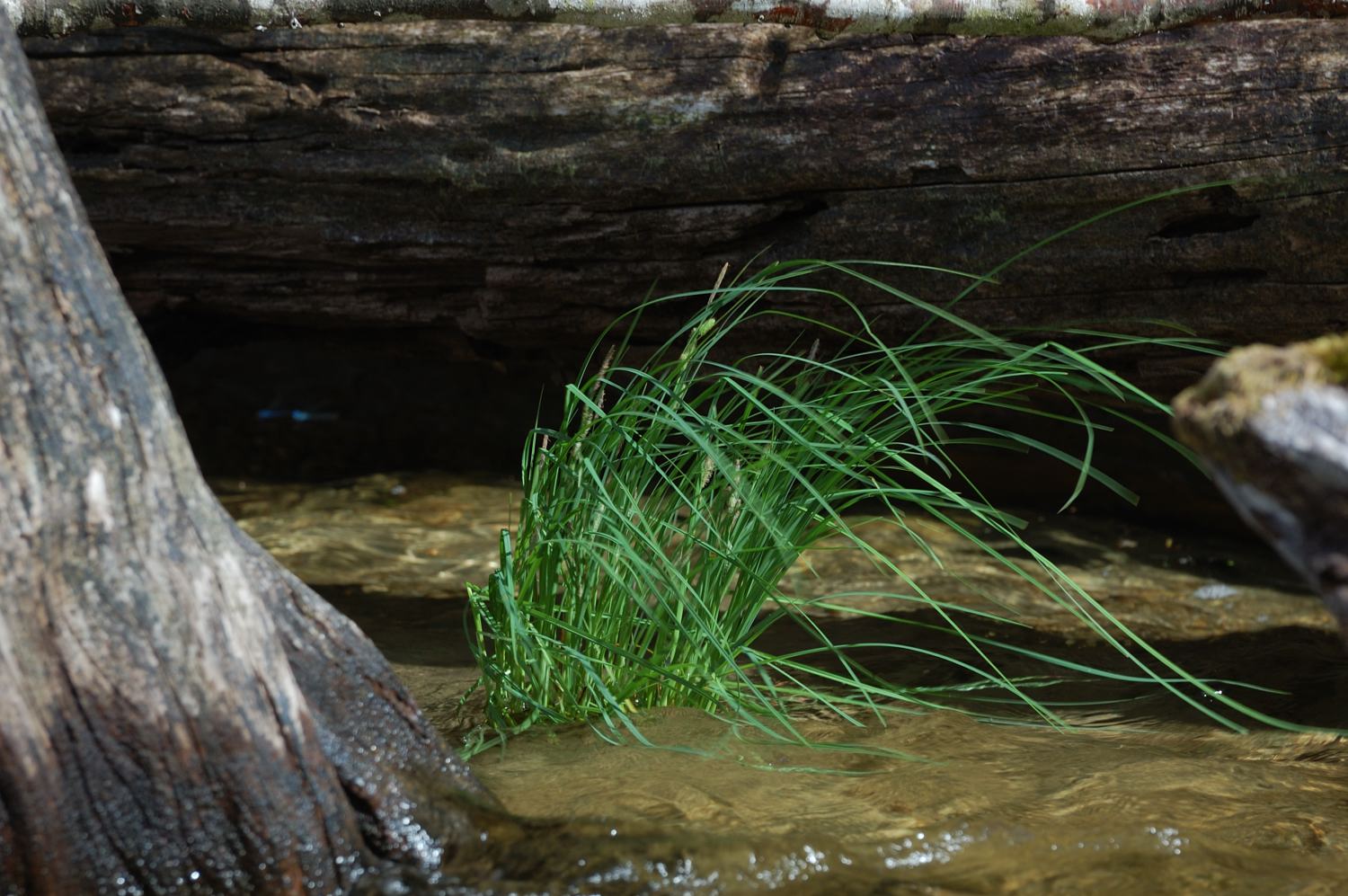
The tufts of grass growing out of the water amongst washed up charred logs had a beauty to them.
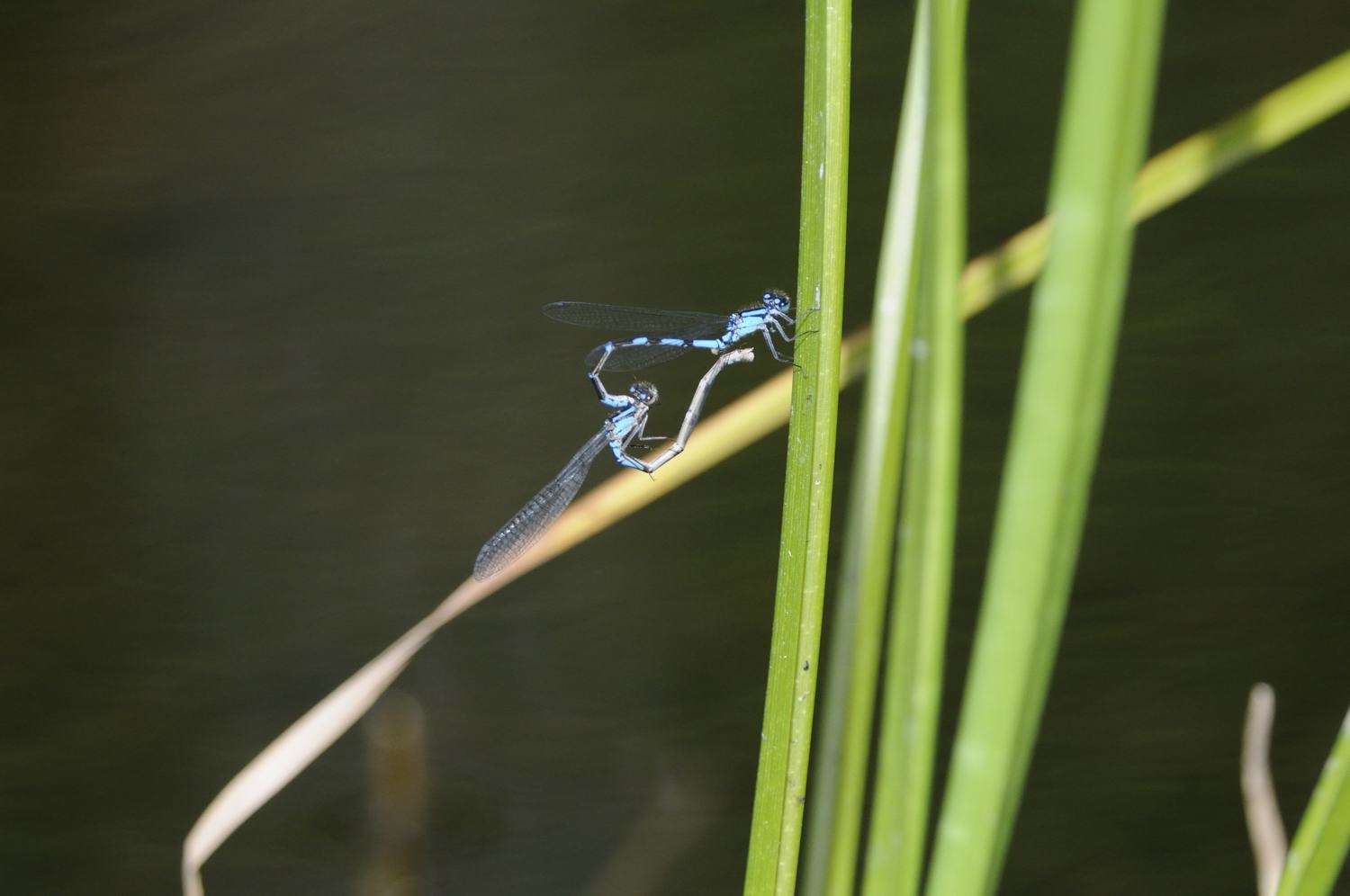
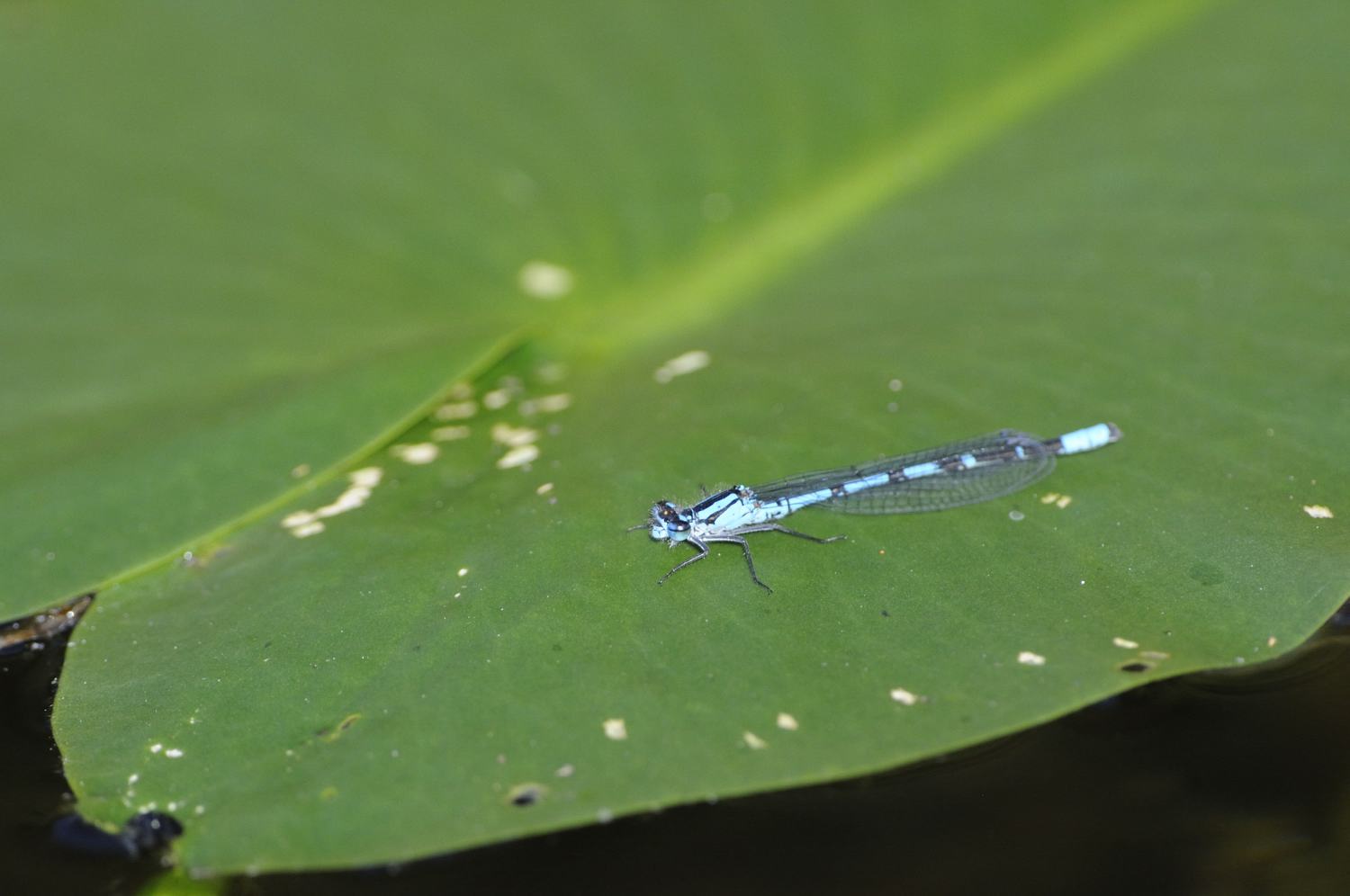
It was beautiful but eerily desolate. I fought my way back to the calm lee at the north end of the second lake. It is marshy here, and a large floating log separates the marsh from the main lake. From a distance I thought this log might be a beach. But no, thre are no beaches on Unwin Lake. I walked along the log and took photos of damselflies and other interesting lakeshore life, waiting for the brief periods of sunshine to get the shots. After a half hour I continued on.


There seemed to be a permanent cloud blocking the sun here. It would give me a minute or two to take some photos, then I would have to wait another ten.

Pond lily ready to open

Shortly after heading out again I noticed something shiny in the bushes on the northern shoreline. It was one of those shiny silver balloons that people release and I always wonder where they end up…. And just to the west of here I noticed an opening in the forest coming down to the lake. I thought I might land there and have a look around as there are supposedly native archaeological sites here. But as I approached, all of a sudden I got a very creepy feeling. I thought I could hear voices but then there were none. The wind was bashing the trees overhead. There were no boats or any signs of people around. It was a very strange sensation. I have rarely gotten so creeped out so quickly. I’ve spent lots of time in the wildernesss but his was more than that. I wondered if it had somethign to do with the native sites here. I high tailed it out of there. Maybe my mind was playing tricks on me since I had not seen anyone all day anywhere on the lake and the wind was getting to me. I really don’t like wind. I don’t know.
I returned to the head of the first lake with a very strong tailwind and I was able to surf down the big waves for several seconds since my kayak was so light.
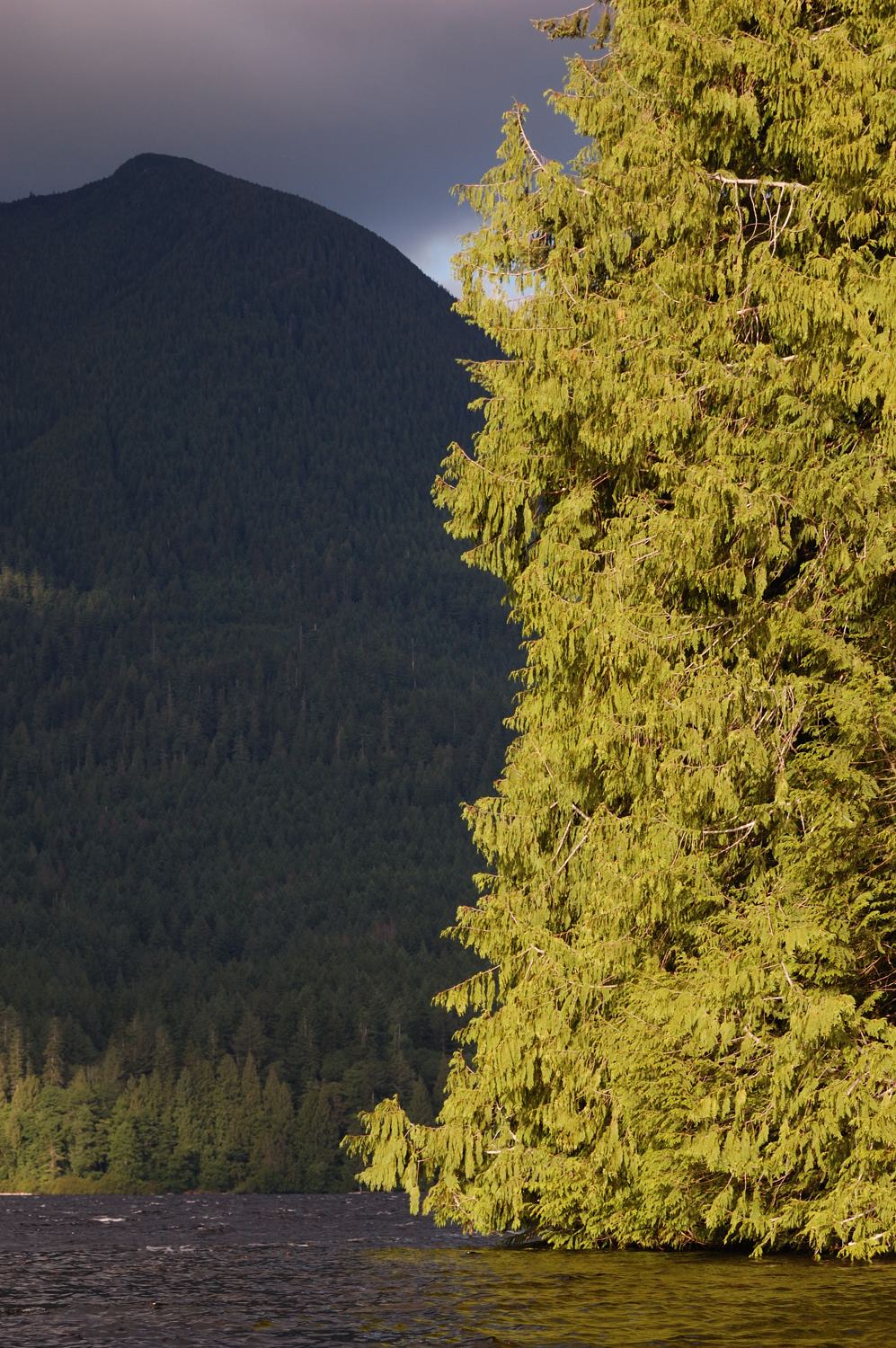
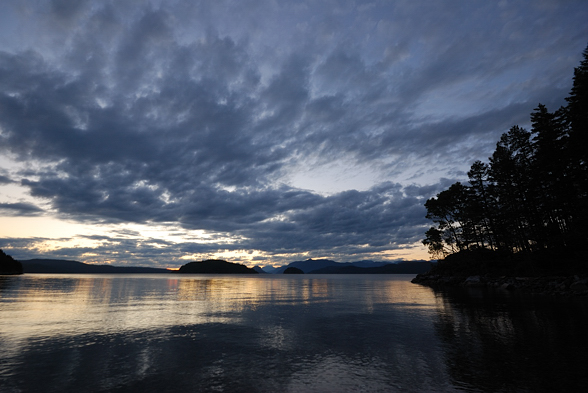
Evening light on the cedars as I returned to the head of Unwin Lake
The creek running by the campsite had lots of fat little salmon in it and a sculpin which I was able to get video of. The salmon were hanging out at the area of the rocks where everyone comes to wash their plates; that’s why they were so fat and showed little fear of me.
This water is very warm, I’d estimate 20 degrees. And it’s only June, I wonder how high it gets in August. I guess Unwin Lake is shallow and just heats up in the sun. I gave my kayak a good bath in the creek. We had more crabs that night and all sat around George and Eva’s campfire.

The following morning George and Eva headed out fairly early. I was also going to head out but I wanted to go back up to the lake and walk around a bit more to get some videos and photos of me in the forest.

A nice big second growth cedar
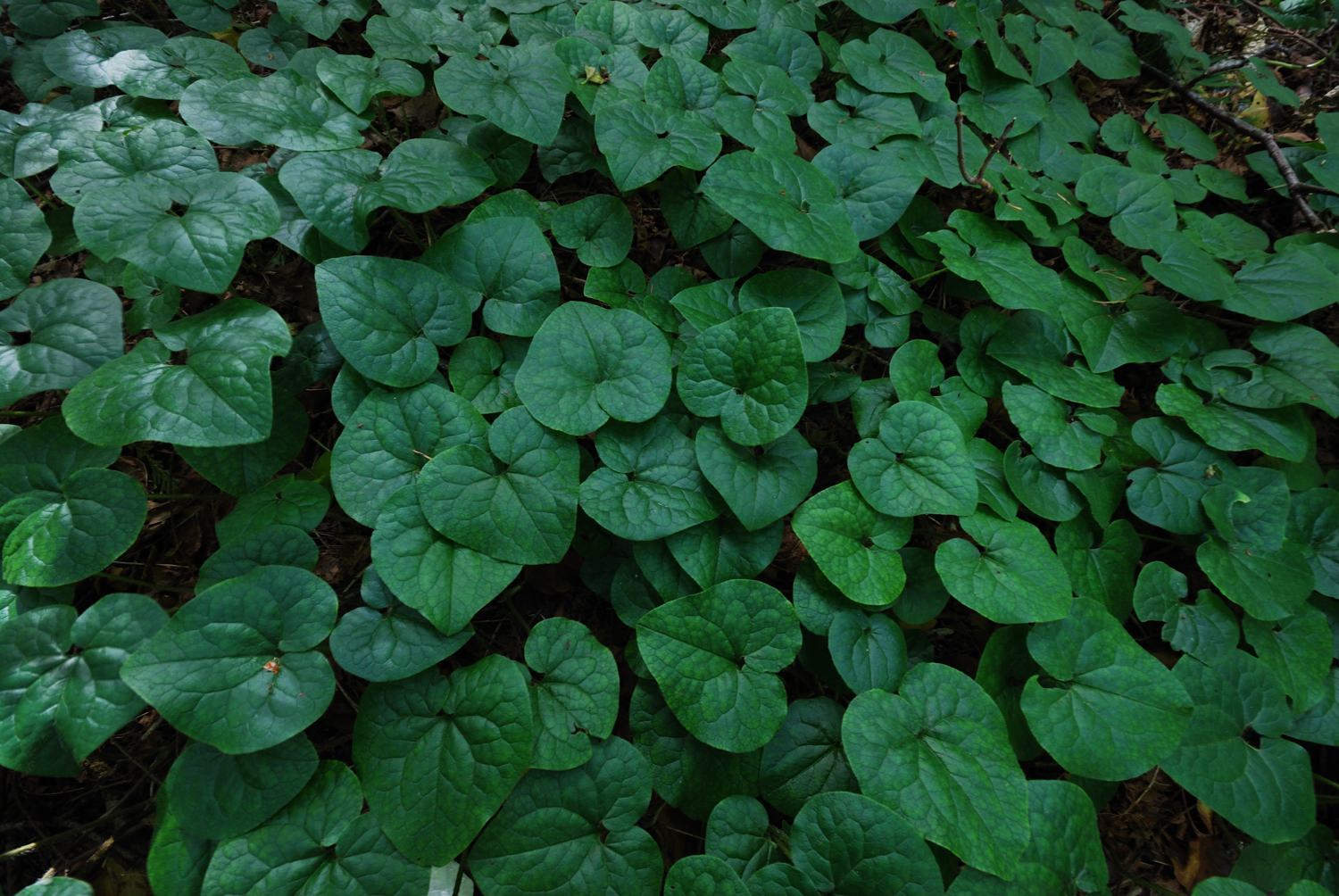
wild ginger

Miner’s lettuce (great in salads)
I returned to camp, hoping to catch Bryan and Maggie. They were going to spend another day here and the plan was to meet up in Big Bay in a few nights’ time, as I was going to go up Homfray Channel to the east which would add an extra day to my paddle. But they were nowhere to be seen back at camp.
They were still in their tent, until lunch time! We finally said goodbye and I headed out.
I passed a sailboat coming in and then approached some impressive sheer vertical cliffs plunging to depths I didn’t want to think about.

I tried getting videos but my camera would slowly zoom in and yield useless footage. This is because I bought a housing for a slightly different camera model than what I had because apparently Canon discontinues making the housings for its cameras that are a year old. This means that the camera didn’t fit properly and the zoom lever on the housing gently pushed on the zoom button on the camera. I was getting very frustrated with this since it ruined some otherwise nice videos. I got some short ones of the subtidal life along the vertical cliff as I went along but they didn’t last very long until the camera zoomed in. I also made some lengthy videos with the camera pointing off the front of my boat, which would be of me paddling along the shoreline from one bay to the next, and then if sped up, the viewer would get a time-lapsed idea of what it’s like to paddle here. These would have turned out great, except of course you know what happened…. I was getting so angry. I took a break in the entrance to the little channel which led out to the beginnings of Homfray Channel. I got out my peanut butter and dates and then noticed that my map was in the water, floating about 50 feet away. Ahhhh!!!!
I ate my food and then I went through the narrow channel into the main channel of Desolation Sound and it was so beautiful, and I managed to get some decent videos, with audio even, so I soon calmed down.
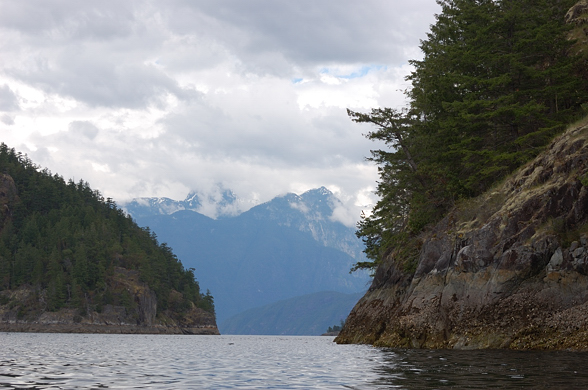
looking up Desolation Sound to the Coast Mountains
But then the weather started to look like it was going to pick up. I could see all the clouds hanging around the mountains to the east where I was heading, getting more and more threatening. To the west was sunshine. This is how it is on the Coast — the mountains trap the clouds and increase rainfall there. This is basically why this region has such a high diversity of ecosystems, ranging from the wet hypermaritime climate on the exposed outer coast, where winter isn’t much different from summer, all the way over the mountains of Vancouver Island to the dry rainshadow climates of Georgia Strait. Then the clouds again get squeezed of moisture when they reach the Coast Range. They get raised higher and higher over ice fields before they again descend down across the dry but cool Chilcotin Plateau of the interior. The Chilcotin is where the polar continental influence becomes more apparent, as winters there are cold and dry. The Coast Mountains form a barrier keeping that cold air away from the Coast, but every once in a while in winter we get the cold outflow winds spilling out to the Coast and freezing everything up for a while until the maritme flow resumes and pushes the polar air masses back into the interior. The Chilcotin Plateau is high too, around 1000 meters. It is bordered by many lakes and valleys leading out from the east side of the mountains which I will explore on the return leg of my trip. Further east, the elevation drops even more down to the Fraser River, and BC even has some dry desert ecosystems. Then the terrain picks up again as you go east from there, leading to another wet belt in eastern BC, followed by the Rocky Mountains, and finally the dry prairies on the lee of those mountains, which go halfway across the continent. And here I was, right in the middle of it all!
So, back to my immediate weather concerns, I could see that I was going to get hit by some wind and rain.

Looking to the northeast up Homfray Channel

Five minutes later
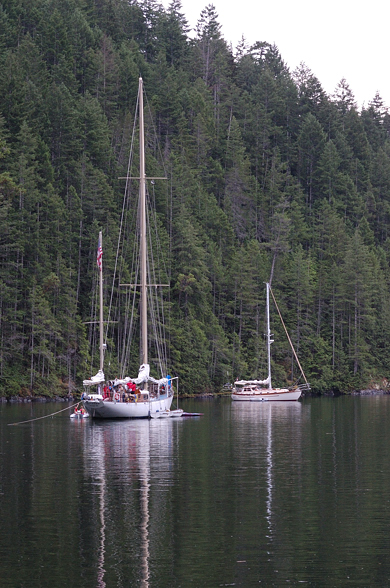
I took refuge behind some protected little islands which turn out to be the other main anchorage for Desolation Sound. Just over the rocks were a few sailboats taking refuge too.
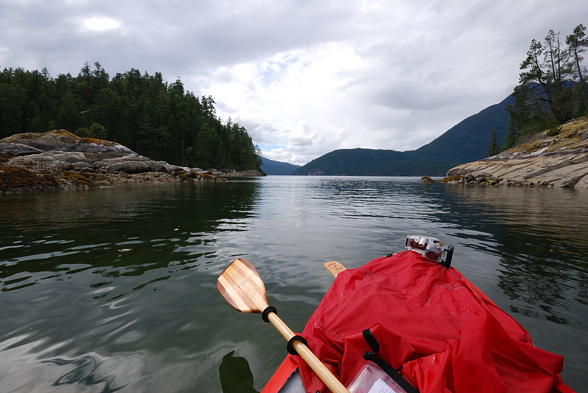
Refuge behind little islands
It really is amazing how many oysters there are here. It is not a safe place for an inflatable kayak for this reason! After a short while of snacking on Quaker Harvest Crunch I again returned to paddling and saw an interesting little channel I thought I could go through. However, I grounded my skeg on the bottom which was entirely covered with oysters. Not a smart move. I retreated with no damage. I guess my skeg protects me from getting into too much trouble.
I didn’t get hit too hard with the weather, it was mostly just wind, and when back out in the open, I took note of how much pelagic (free swimming) marine life there is in these waters. It is like pea soup it is so productive. That’s probably also why there are so many oysters! There are jellies everywhere, and millions of little comb jellies or ctenophores on the surface. These have rows of cilia hairs along their bodies which refract sunlight like a prism. They are very beautiful to look at in an aquarium or under a microscope. I have seen them everywhere on this whole trip but especially here, where they seem to raft together on the surface by the hundreds.
I noticed some birds of prey swirling overhead way up in the clouds.

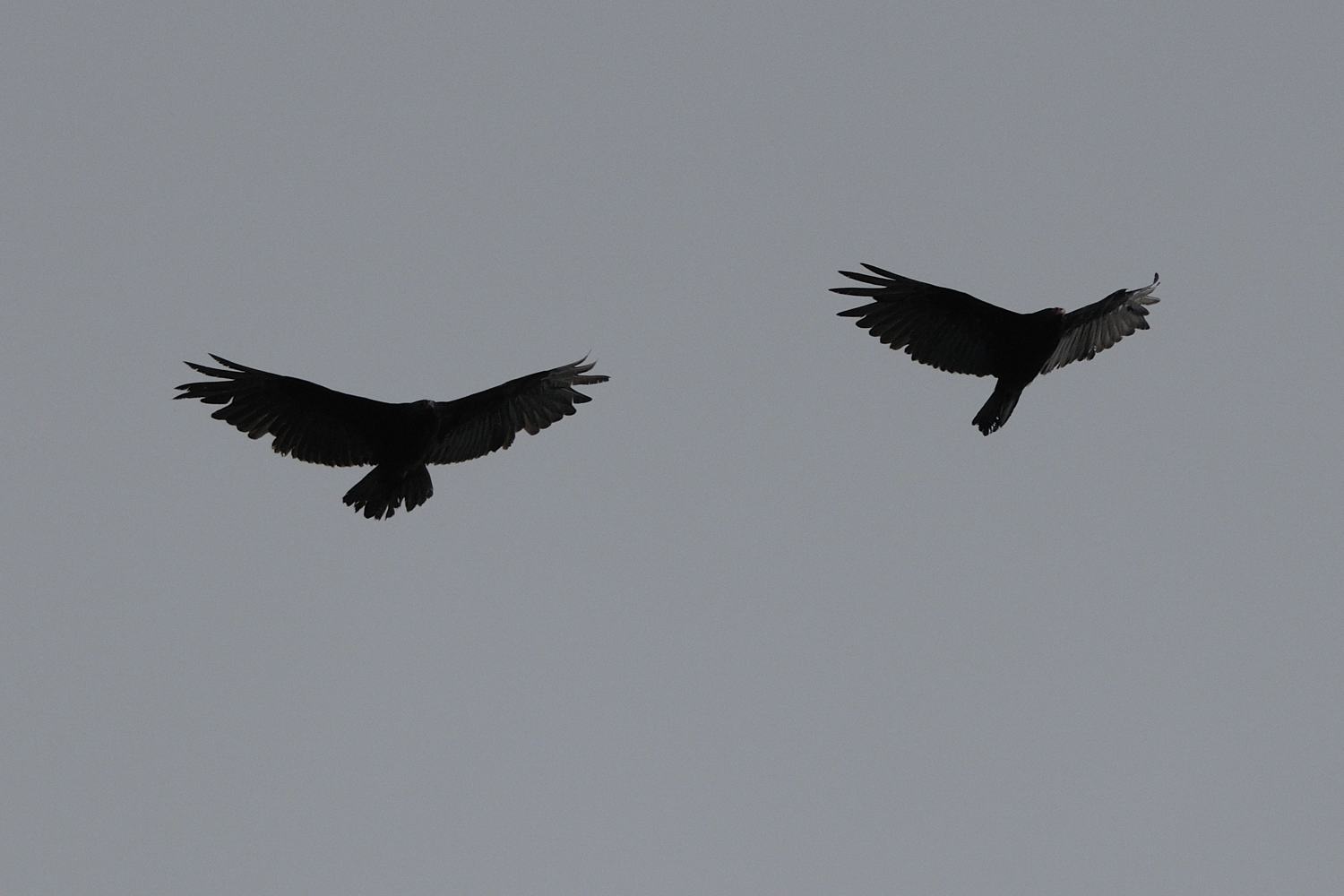
Turkey vultures

Then I rounded a corner and came face to face with both eagles and buzzards sitting on a log! I pulled out my camera and got some nice shots as the wind pushed me by.


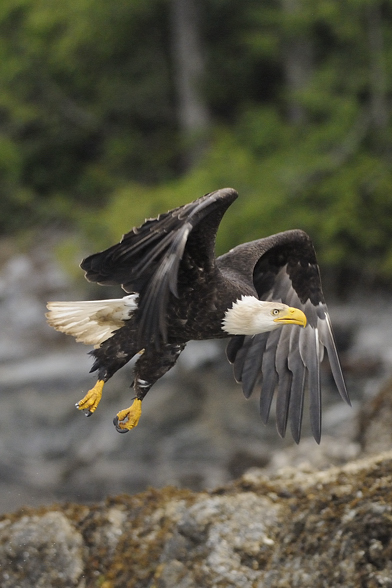
I started to realize how much animal life there is on this planet when you get away from human civilization. It really is another world out there!
The late afternoon light was really nice against the mountains and I had a strong tailwind pushing me up the channel.
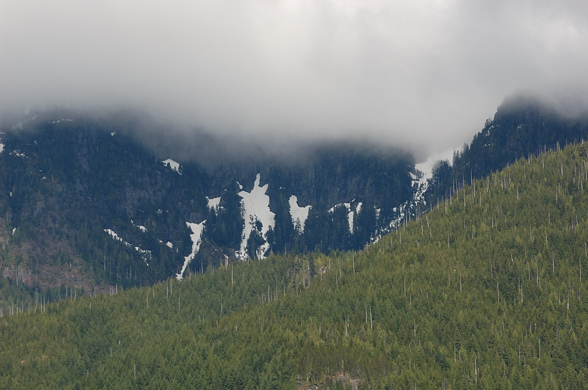
Mountains of the ecological reserve of East Redonda Island

Looking north up Homfray Channel


I tried trolling for whatever fish were out there but caught nothing. I neared my destination for the day, what seemed to be a bankrupt fishing lodge for sale which had been started but abandoned. And there was an oyster farm right off the shore in the bay. Steep mountains flanked the bay and a nice big creek flowed onto the rocky beach. This area was desolate with few boats coming by, and the oyster farm seemed vacant.

Interesting garage. I wonder what the morning commute’s like?
I landed almost on high tide in waves and scrambled to get my stuff organized.
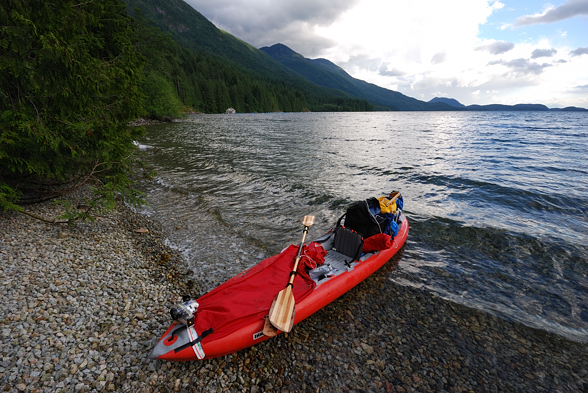
There was a great big grassy area where I could set up the tent but as I arrived I scared a goose away. Apparently the goose was enjoying the grass too and there was crap everywhere. I managed to find a clear spot behind the cedar tree in the above photo and just as I got my tent set up it started to rain hard. It lasted for an hour but I made dinner under my tarp, which I set up just before the rain ended. Oh, and I lost my lure out there somewhere too.
This looked like a risky bear area so I tried to hoist my food up a tree but failed and it got dark and wet so I just put it by my tent and would defend it if anything came by.

In the morning I noticed a little critter the size of a squirrel racing by above the beach. This was some kind of weasel, I will have to ID it later. It had a big white patch on its chest. I walked over to where the creek emptied onto the beach to filter water and fill up my water containers. That water was cold on my feet! Straight down from the snowmelt.
The salt water was pretty choppy and the beach had oysters, so I searched for the most sheltered spot to launch, which was a few hundred meters down the beach to the west. These oysters are a mixed blessing. They can shred your boat and feet, but they provide easy bait for the crab trap.
I spent most of the day paddling up the coast mainland by the big snow capped peaks.

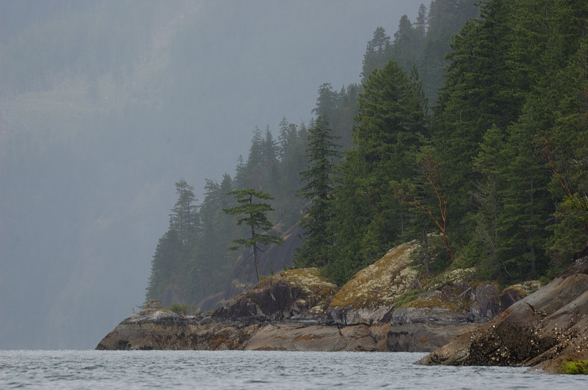
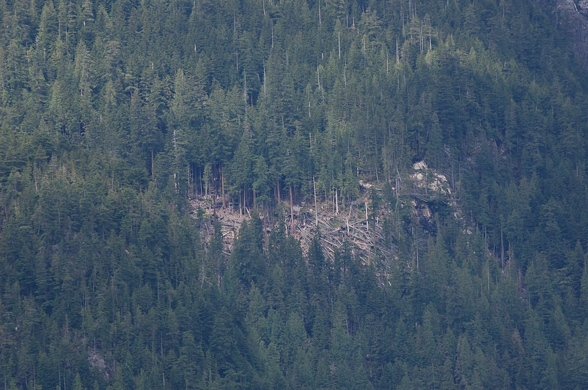
Windthrow on East Redonda Island

Why do you think these mussels only grow on the branches hanging down into the water? This was a special habitat I would paddle by every hundred meters or so.
The water here was more devoid of obvious life, and the intertidal was more sparse compared with Desolation Sound. It was clear and dark blue, rather than the pea soup of Desolation Sound. I attribute this to the depth of the channel, as well as the fresh water runoff from the coastal rivers flowing into it from Toba Inlet, which tends to stay near the surface at times and reduce the salinity. Toba is a big inlet with big rivers, but even those can’t penetrate through the Coast Mountains and drain the Interior. I’d have to wait a few days before I got to that inlet….
There was the odd house and fishing lodge but mostly it was uninhabited. There is more parkland up here, obviously with Desolation Sound Marine Park prominent, but the entire eastern peninsula of East Redonda Island is an ecological reserve.
I continud up the eastern side ofthe channel and investigated a high waterfall coming off the mountains straight into the water. There was a rope swing here where youcould jump into the salt water. I didn’t try it out.
At some point I had to cross west over to Redonda Island from the mainland shore and I made the decision to do it, even though it wasn’t at the narrowest point which was a little further on, because the conditions were calm. I thought I should take advantage of my good fortune while I had it. It’s good I did this because literally, as soon as I got close to reaching the opposite shore a strong headwind gust picked up and made it very difficult to paddle. I hopped along the shore from one sheltered bay to the next and rounded the northern point of East Redonda Island.
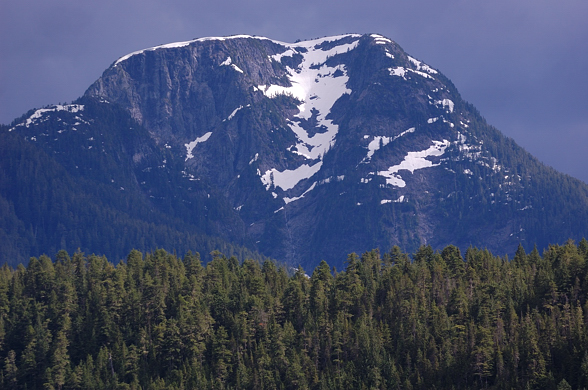
I had winds for the reast of the paddle, which wasn’t actually much longer anyways, and made it to the sizeable bay which had the campground, next to a logging operations dock. I was now beyond the ecological reserve.

At the camp were four Germans and their guide. I stayed with them and set the crab trap in the wind but caught nothing. Soon the weather picked up even more and became torrential with high winds. They had a big tarp set up among the logs on the upper beach and somehow they managed to keep that together. Good construction! We all huddled under it and watched the storm.
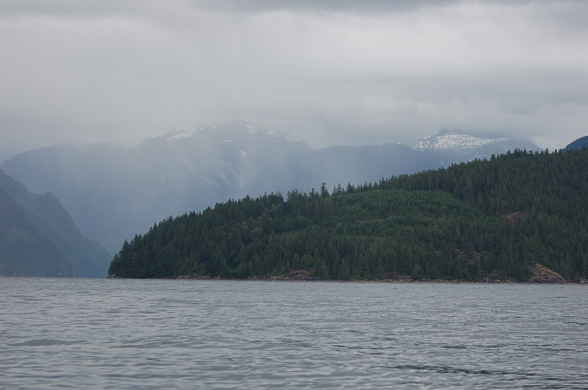
In comes the weather from the north

Torrential
The guide Rory was kind enough to offer me some dessert, even though I had lots of my own food. Sweet apple crumble, wow. He knows how to take care of his guests. I also stuffed myself on dal and I added my own rice to beef it up.
Rory said he was planning to kayak up to Haida Gwaii next summer with some friends. He asked about Homfray Channel since he hadn’t been down there before and I mentioned there were suitable camping sites along much of the eastern shore, in the big bays. I said a few looked like they might have bears but I didn’t see any. He seemed to try to end that topic quickly, I presume to not worry the guests. He said that the kayak up Toba Inlet was spectacular, and that there was a campsite on some rocks underneath a huge steep mountain.
There was not much space in this campsite and they had taken the main open area. There was another older tent site which had become partially overgrown so I took out my axe and hacked it back.


In the morning I felt bloated and I saw the Germans off. I would be a little slower getting packed up.

Away they go, to where I just came from
The sun was poking through so I set up my solar panel on the rocks and took some photos.

The little creek here has Enteromoporpha sea lettuce growing along its bed. This algae grows wherever there is fresh water entering the intertidal. You can eat it.
I finally got going but I was not feeling any less bloated. The oatmeal I had for breakfast sure didn’t help either, and only added to the rice. I felt like I was going to throw up.
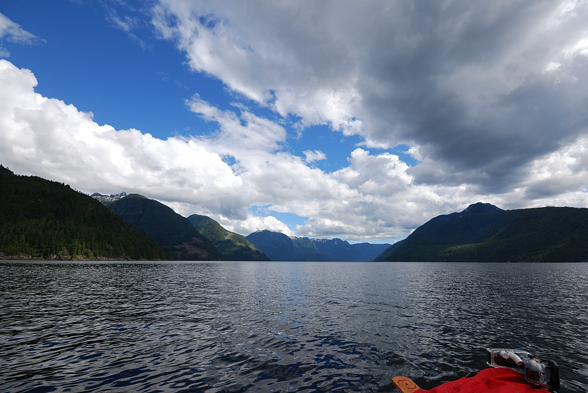
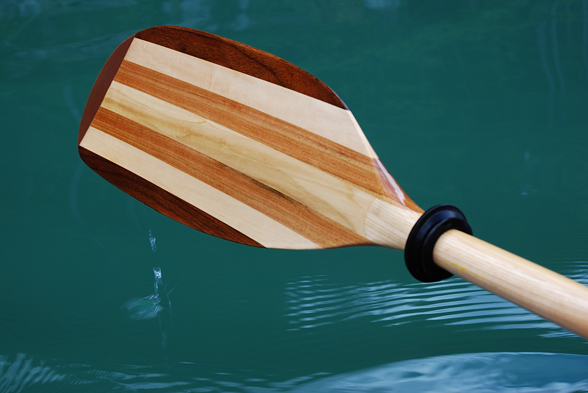
I just paddled weakly along the shore in nice calm seas for a few hours. The water had become turquoise blue from the glacial runoff from Toba Inlet.
I was hoping that the currents would be going swiftly my way and that I could just lie back and snooze for a half hour at a time as I floated along. But they weren’t strong enough and I gradually became stronger myself so I put effor tinto paddling, in order to take advantage of the currents before the tide changed. There was the odd explosion rattlign the whole area, from forestry workers blasting rock for road building. I was hoping to intercept Bryan and Maggie at the channel separating East and West Redonda Islands, since they were planning to come through there that morning, but I didn’t see them. I passed a few other kayakers.

After a few hours I started to feel much stronger and the currents really started pushing me along.
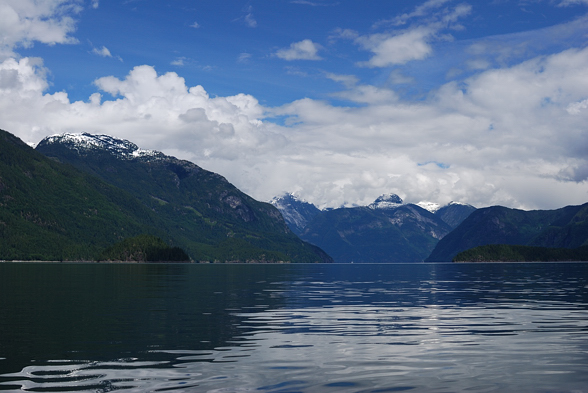
Looking back up towards Toba Inlet
I made good time and rounded the northern point of West Redonda Island to reach the channel separating it from Raza Island, which I would have to cross. I made some neat videos with the current taking me along the steep shoreline as I looked down at saucer sized moon jellies. I took a break and filled up on dates and peanut butter, then crossed uneventfully.

I passed along Raza Island and crossed again to a peninsula of the mainland that sticks out. I rounded the point into the bay with my planned campsite, a nice cobble beach, but there was no cleared campsite in the bushes. There was a spot above the high tide line on the cobbles so I checked the tide table and the high would be at 8 pm that night, with the low in the middle of the night being lower, so I was safe. I enjoyed some curry dinner as I sat in the big logs and watched boats going by.

The next morning I said goodbye to the last arbutus trees as the climate was getting wetter from here on, and I had a short paddle into Big Bay on Stuart Island. I had to cross the entrance to Bute Inlet, which Stuart Island fits into like a plug. I later found out that Bute Inlet gets to 700 meters deep here. The boat traffic was noticeably heavier because this is one of only two locations which allow passage north and south along the coast. The other is adjacent to Vancouver Island, on the other side of Sonora Island.
This is an interesting place because everything gets funnelled through here — the boats, the log booms, the water, and the salmon. The northern portion of Georia Strait gets funnelled through these two openings when the tides change, so the water really gets going! There are some very dangerous rapids leading into Big Bay, which must be negotiated at the right tide. Whirlpools seven feet deep can develop and swallow kayaks. The books all warn to be very careful here. I was approaching at the beginning of the ebb tide and I stopped near a very swanky lodge to ask a guy on the dock, a chef, about the rapids. He didn’t know much about them.

I went anyways and had some fun getting whipped around the points and carried into Big Bay. More and more ultra swanky resorts showed up. Wow, what a place. All of them had No Trespassing signs.
This is also an interesting point on my trip because Bute Inlet hosts the second river, after the Fraser, which drains from the Interior out to the Coast. So far , which is differentfon my trip, all of the rivers leading down to the salt chuck have drained the west side of the mountain range, but here, the Homathko River drains parts of the interior Chilcotin Plateau (Tatlayoko Lake, which is different from the other similar lakes it has as neighbours because they all drain eastwards into the Fraser system). I have no time to go up Bute Inlet; it’s way too far, but I plan to hit Tatlayoko Lake and the Homathko River on my way back down next year as I mountain bike my way through the Chilcotin mountain wilderness along the many trails in the region. I also plan to tow a smaller kayak with me and use this to cross lakes when I need to.
I arrived at the public dock in Big Bay to see Bryan and Maggie greeting me! They had just arrived and had only been a little ways ahead of me for the last couple days! I must have just missed them as they came through the channel between the Redonda Islands.

I learned that Big Bay had very few supplies despite all the swanky resorts around. The store opened from 4 pm to 5 pm and had only dried and canned food, but that was enough. I got some canned chunky soup, crackers, honey, peanut butter, fishing lures, and of course chocolate bars.
Apparently Big Bay has been around for a while and anyone who’s anyone has been there. Royalty and Bill Gates have visited. Since everything gets funnelled through the channel here, including the salmon, it offers great salmon fishing opportunities, especially of the runs originating out of Bute Inlet. It’s a great place to build a fishing resort!
The “resort” across the water was London Drugs’ corporate retreat, and Denny Washington has two, a personal and a corporate retreat. We watched a couple helicopters fly in, circle the bay, and land at London Drugs. Then a bunch of greeters went up to meet them so they must have been important people. I got out my long lens like the paparazzi.
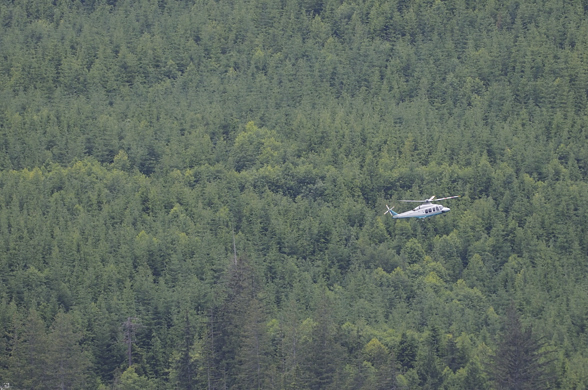
Doing the circle tour
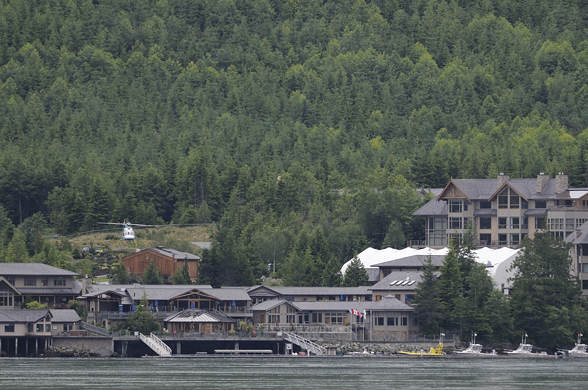
Landing

Recognize anyone famous?

Bryan and I caught some ling cod off the dock and one of the guys working at one of the lodges brought over two huge slabs of salmon! We ate well that night, over the fire pit on the lawn! We pitched our tents in the covered area next to the store. And at one point a couple whale watching boats unloaded and everyone came up to eat their lunch on the tables near our stuff. These are very powerful zodiacs out of Campbell River and they go all over the place chasing the whales, guided by radios from planes and other guides. We talked and then as they left, they left their food with us!





























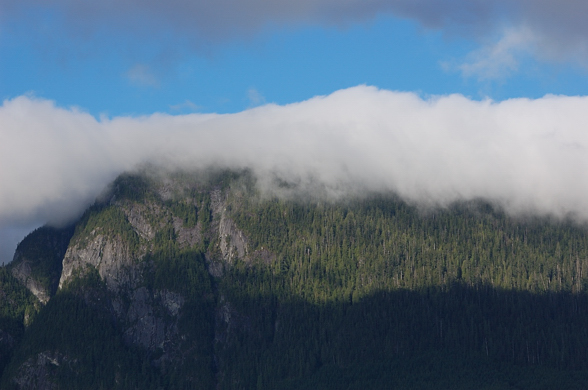
 Around the Coast Mountains