Latest

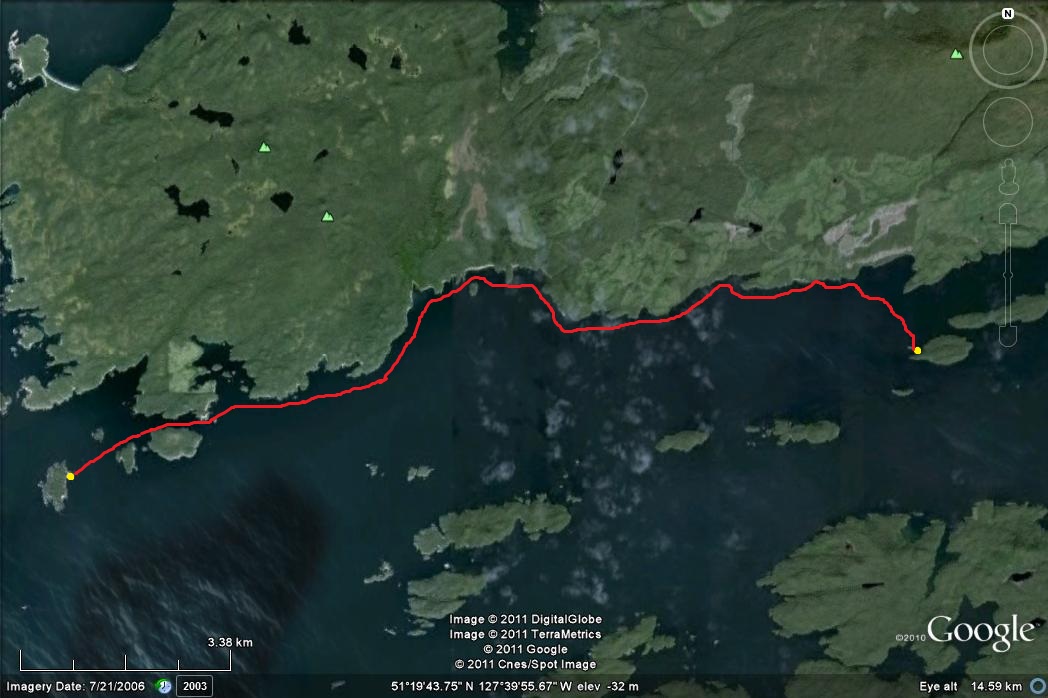
July 15 – To the Edge of the Continent

It was cloudy in the morning but not raining so I packed up and made the difficult gear transfer down the slippery rocks to a flat muddy area at the bottom with eelgrass. This little island is actually connected to the main island at really low tides. There was a wide diversity of marine algaes / seaweeds here, exposed at low tide.

As I was finally getting ready to go, the rain picked up, but that was okay because I was in my drysuit. I came prepared! I immediately crossed over to the north shore of the inlet and began searching for a creek from which I could fill my water bottles because I was getting very low. I wanted a little stream, not a raging river, since the stream would be groundwater that I wouldn’t have to filter. There were tons of streams with all the rain; it was just a matter of finding one that was easy to access.

I came upon this nice beach with a little creek running into the sand.
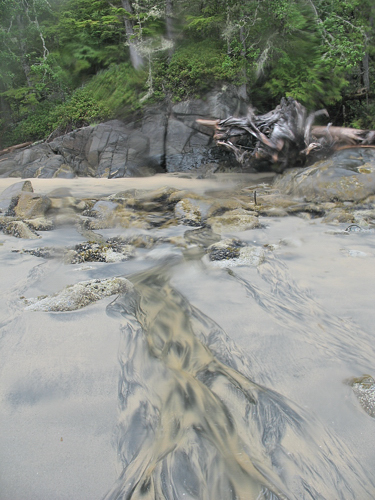
I used my underwater camera housing because it was so rainy, so the pictures are all blurry.

That's where it came from -- perfect!

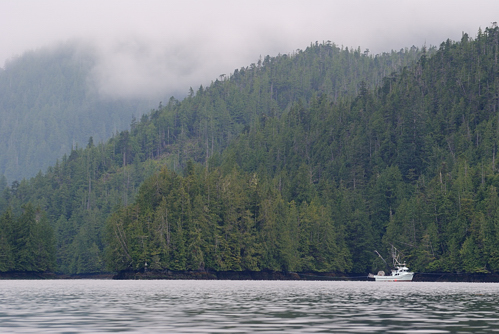
A fishing boat went by as I started off again. I went past another beach with a big raging creek. The rain started to taper off so I pulled my head out of the drysuit since I was getting too warm.

I continued on for a while, following the interesting shoreline as I moved west towards the open ocean. I came upon a bay with a large brown sandy beach and I went in to investigate.
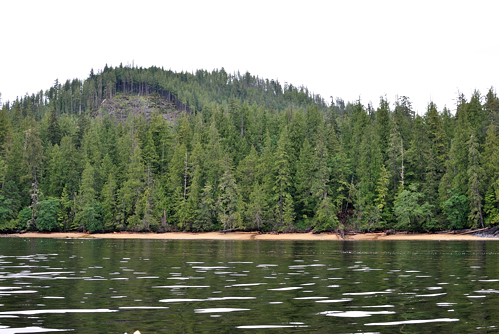
There was a succession of about four of these beaches, really nice. I don't know how easy it would be to find a spot to camp above the tideline though, with these midnight super high tides.
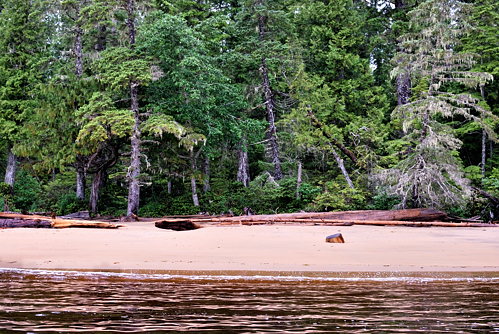
But the water was very brown from all the runoff. I almost thought it might be an algae bloom.

One of the sources of brown, a tea-like raging stream, with goops of foam drifting away in the salt water as it entered.
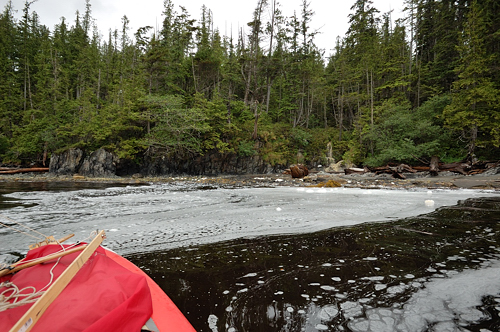
Streams of foam. The sea water here was like tea.

Rain off in the distance
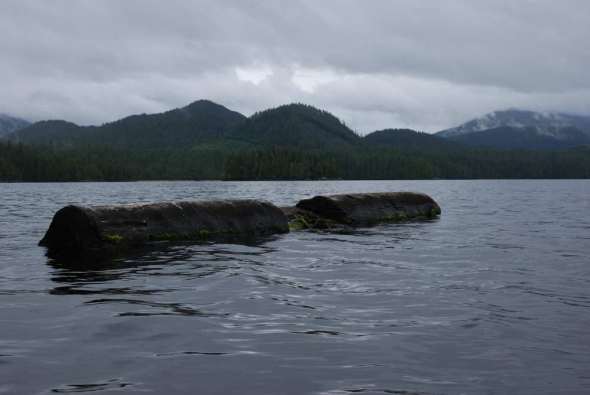
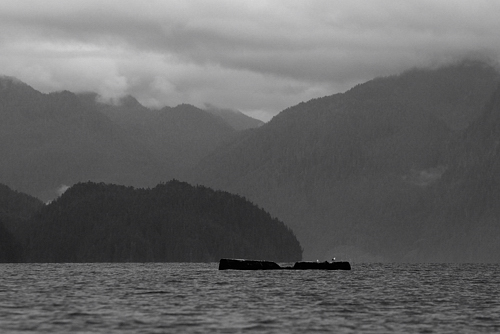
I came upon another of those interesting floating logs.

My destination was a little island out at the mouth of the inlet, where there is supposed to be a beautiful sandy white beach on the lee side of the island.
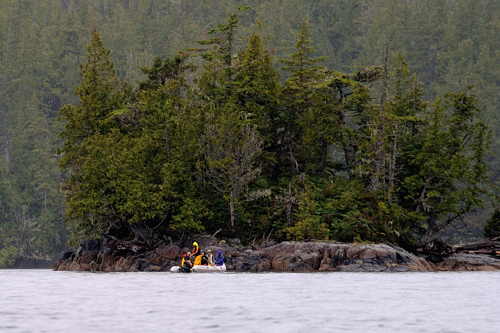
As I was reaching the end of the mainland before heading across to the islands, a final bay presented this interesting sight -- a zodiac full of people in survival suits paddling to the rocks. I didn't know what to make of it. In retrospect I probably should have gone over to see what was going on, but they didn't gesture for me. And they had nice yachts anchored just to the left of here in the sheltered bay.

I donned my drysuit again as I crossed over to the islands, especially since the weather was staring to close in.
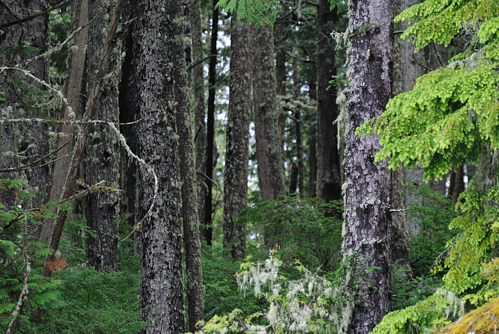
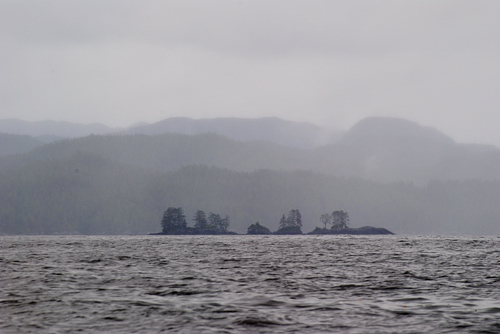
Here it comes.

I crossed over to Brown Island as the rain started pelting down. As I was approaching I startled a pair of sea lions about 30 feet off the bow.
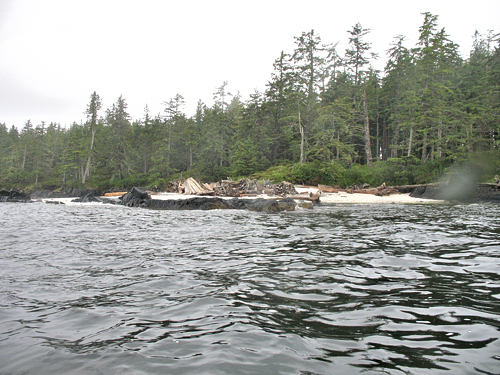
The problem was that there was a lot of waves here and landing on this beach wouldn't be simple given all the rocks just below the surface. I paddled over to the left and found a spot that might allow me to land.

I waited until a break in the waves and then raced in over the reef in a foot of water. Just as I was landing a big wave came up behind me and if I hadn’t been perpendicular it probably would have knocked me over. I pulled out ASAP.

The beach was brilliant white crushed shell.

I played with my underwater still camera in the tidepools. This is a green surf anemone, which only grow in the tidepools on the exposed west coast. They can also dry out for short periods too.

Surfgrass

Usually these half in / half out shots are in tropical locales with coconut palms above and coral reefs below.


It was still raining and I got a little sleepy so I took a nap by lying on a log in my drysuit. It was very comfortable, just the right temperature to be lying in the rain.

Then I took my drysuit off, and now it wasn’t so warm! Those things really work.
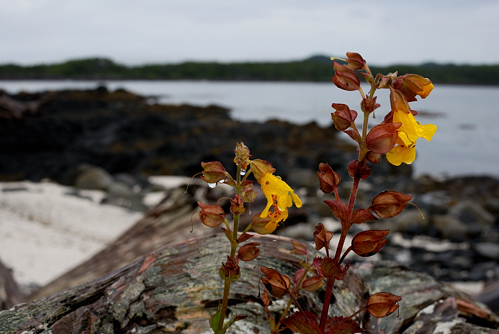
 

This beach had a beautiful little wildflower meadow of primarily coastal strawberry, but also lots of other interesting plants thrown in. Here is Indian paintbrush.

I decided to set up the bat instead of the tent and sleep on the sand because the bugs didn't seem too bad.

I lay under the tarp and had a nap for a couple hours and collected this much water off the drip. I hope there aren't any toxins leaching into the water.

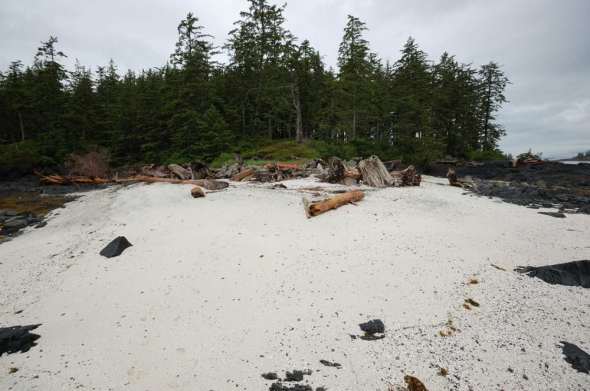
Brilliant white sand

So many types of shells
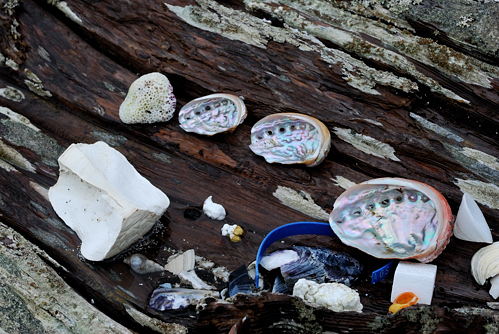
Some abalone shells, or "mother of pearl". I did a little garbage cleanup and surprisingly there was very little.
Looking south across Smith Inlet

I even pulled out my computer to check Google Earth and to charge my GoPro cameras and download photos. I didn't know if I'd have sun again to charge the GoPro's so I decided to sacrifice my computer's battery. The sand wasn't a problem at all because it was the perfect size -- large enough that it doesn't stick to everything and get everywhere.
July 13 & 14 – The Weather Gets Wet(ter)

There was a really low tide in the morning. The tent was nice and dry for packing up too.

I was up early and launched in a little tiny beach down there by 8 a.m. A few minutes later, and the beach was under water, so I timed that well.

It was cloudy and I had a slight tailwind. And the currents were going my way too. I made an easy 7 km/hr and knocked off a few kilometers in no time. How so much easier this was than 14 hours previously when I was fighting the winds to the campsite. Sometimes you just need to know when to call it quits and relax. Work for the sake of work is pointless, counterproductive, unless you are doing it for the physical exercise. I say the same thing about economics — our constant struggle to grow our economies bigger is futile and ultimately self destructive. We need to stop.

Some dispersed heli-logging cutblocks across the inlet. This is an interesting situation because the smaller cutblocks look nicer and result in less disturbance, but the direct implication is that we aren't ever going to have another large contiguous block of mature forest there if we continually rotate it through these dispersed small cutblocks, which aren't ideal habitat for certain animals like spotted owls that need large contiguous blocks. But, every piece of land is managed for different objectives, so this may be appropriate for this location.

Those poachers just never quit.

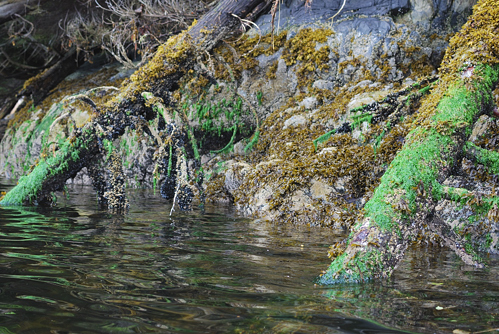
Even way up here I'm seeing the same patterns on logs I did down south. The log on the left is covered with mussels (which are the black things), whereas the log on the right is devoid of mussels. Why? You see this every 50 meters along the shore.

After about 6 km, a headwind picked up, but I had still done a respectable haul in the early morning hours. After this I paddled along the shoreline closely, hugging the coves to stay out of the wind.

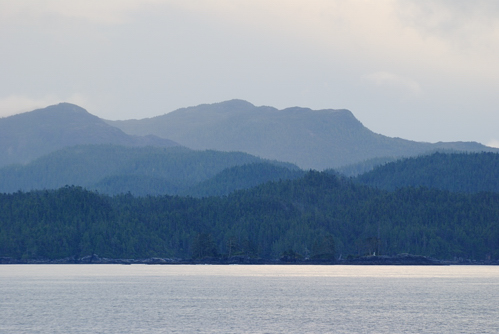
Looking out towards the ocean

There is a lot of floating plant debris out here, from both the terrestrial and marine ecosystems. Much of it enters via the rivers. There is often an oily sheen on the surface which is all the biological oils accumulating with the tides and winds. This is ecological productivity in its raw form. Here is a salal leaf turned red.

It is not uncommon to see skunk cabbage leaves floating around in the salt water, They likely got there from grizzly bears ripping the plant up in the muddy parts of rivers and then eating the succulent stems and leaving the leaves to wash out into the ocean.

This was an interesting tethered floating log which I think had something to do with the relatively fresh adjacent cutblock.

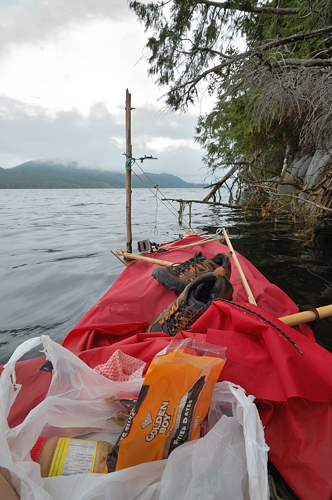
I tied up to a cedar tree and had lunch (dates and peanut butter) with the wind keeping me in my spot. I made a little video commentary but the batteries on my audio recorder soon died.

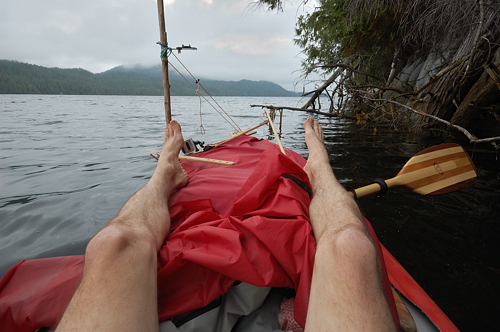
You can't do this in most kayaks. And you also can't climb up to the front of the boat either. And you also can't stand up in most kayaks.

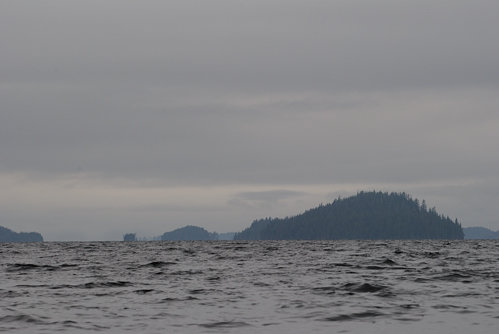
I continued on and now the ocean waves were becoming noticeable. There are quite a few islands out in the mouth of the inlet which break up the swell but I was now starting to experience it, the closer I got.

That's the open ocean out there in the gaps.

I followed the shoreline a bit more and the rain started. I turned on the video camera to record what it’s like in a squall as I paddled. At this point the north shore of the inlet reaches a point, and doubles back a bit before heading up north and then west again. I had the choice of crossing some open water in this weather or following the coast back and crossing up north amongst some islands where it would be safer. I chose the latter.

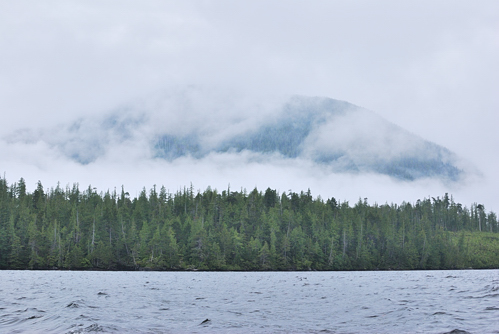
The weather was making interesting mist patterns on the nearby mountains.

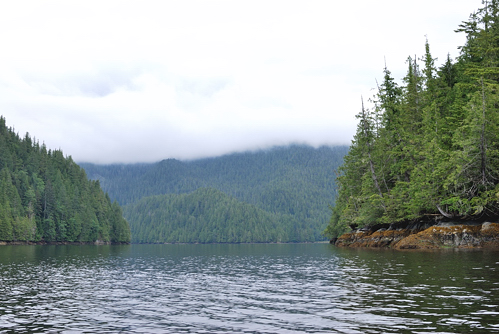
Hues of green

I crawled up the north side of Dennison Island, all the while scoping out potential campsites as I went. I didn’t see anything obvious and I crossed over to the next island to the west, which had some rocks at its exposed end that I was hoping would be suitable. But the rain was really starting to pick up. I could see it coming in from the west. I crossed over to the island before it hit and took shelter under a big overhanging cedar tree, maintaining my spot with the odd paddle stroke against the wind. I would stay here until the weather abated. After 1/2 hour it didn’t and I had to make the decision to move on in the rain. I was only in my rain gear, not my drysuit, so I would get wet. But if I could pull out for the day that would be OK.

I got to the rocks and the pullout was difficult, but doable.

The pullout was up the slippery and tortuous jumble of big rockweed-covered rocks,all in the pouring rain.

I got my stuff up but I didn’t want to open it because anything inside that was still dry would then get wet; it was still pouring rain.

I stood around for probably an hour waiting for the rain to end, which wasn’t. I was getting wet and cold. I was not a happy camper, literally.

I realized I had to do something so I managed to cook up some fettucini alfredo which wasn’t very good, but it warmed me up a bit.

I became totally soaked. I was getting cold, frustrated and angry. I yelled my profanity and frustrations into the weather. I finally bit the bullet because I had no other choice, and tried to set up the tent with the tarp in a small and contorted space on some rocks. This did not work.

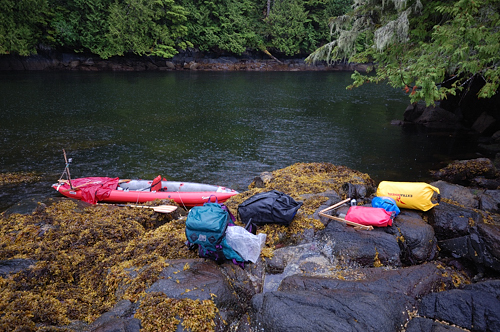
To get my tent out of the way I moved it onto these rocks temporarily. Magically, I had found my tent spot for the night. Sometimes I amaze myslef at the spots I can sleep in. Yes, that is three boulders I was draped across.

I got my stuff semi-organized and I hunkered down in the tent for a while to listen to the weather — a quasi stationary trough in Queen Charlotte Sound was sending waves of rain out. Well, that’s where I was, and that’s what I was receiving.

It rained all night, but miraculously it stopped mid morning the next day. I wasn’t going anywhere that day; it would be my day off. If I tried to pack up now everything would become soaked.

I got up and sort-of dried out. There was a hummingbird hanging around, going in the little salal flowers. My breakfast was some apple cinnamon oatmeal. A banana slug seemed to really go after the residue on the oatmeal packet. I threw the slug into the bushes. Then I thought about how long the banana slug population has been isolated on this little island, off the bigger island, which itself is isolated from the mainland.

I felt sorry for myself, thinking that I am the only life form here that can’t handle the rain. Nothing else cares about it, they just go on with their lives regardless.

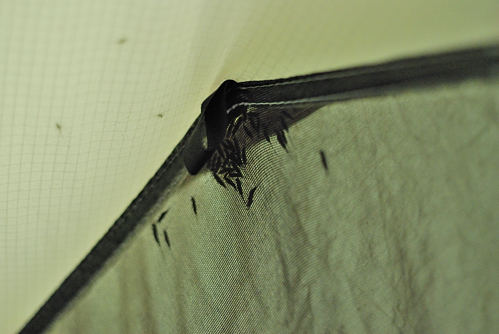
Then I saw all the silverfish bugs taking refuge in the dry corners above my tent in the morning, and realized that I may not be alone in my desire for dryness.

There were frequent salmon jumping out there.

I didn’t do much all day; I mostly sulked. I had a bath in the ocean, and took some video footage of waves coming into the tidepools. I didn’t even open my camera bags because they were soaked.